Gemini 4 Argon vs Claude Opus 5.5: Which Should You Pick?
Gemini 4 Argon is half the price of Claude Opus 5.5 until November 30, then identical. Here is where each wins on benchmarks and which to pick for your workload.

7 min read · Last updated: October 25, 2026
Gemini 4 Argon vs Claude Opus 5.5 comes down to price timing and workload. Argon is half the price until November 30, 2026, then costs exactly the same. On Google's own scores, Argon leads on long context and issue-style coding, while Opus 5.5 leads on terminal-heavy agentic coding.
Came here from Instagram, LinkedIn, X or YouTube? Here is the full source list you came for. Everything below is built from these, nothing else.
The announcements
- Gemini 4 Argon launch post, Google, Oct 13, 2026
- Claude Opus 5.5 overview, Anthropic docs (released Sep 22, 2026)
The prices
The benchmarks
The reporting
Key takeaways
- Argon costs $2 input / $10 output per million tokens through November 30, 2026. From December 1 it is $4 / $20, the same as Opus 5.5.
- Both models have a 1M token context window.
- On Google's model card, Argon beats Opus 5.5 on DeepSWE (77.9% vs 74.2%) and long-context GraphWalks 256K to 1M (84.2% vs 66.8%).
- Opus 5.5 wins Terminal-bench 4.0 (66.4% vs 57.4%) and FrontierSWE v2 (62.3% vs 55.0%).
- Every Argon score here is vendor-reported. Test on your own repo before you commit.
Gemini 4 Argon vs Claude Opus 5.5: the decision in one line
Pick Opus 5.5 if your work is long-running agents in a terminal. Pick Argon if you feed it huge inputs or run pipelines where cost per token matters. After November 30 the price gap disappears, so choose on fit, not on the launch discount.
That is the short version. The rest is the evidence.
How do the two models compare side by side?
The two models match on context size and, from December 1, on price. They differ in thinking behaviour, availability and where each one wins on benchmarks. All figures below come from the vendors' own pages.
| Gemini 4 Argon | Claude Opus 5.5 | |
|---|---|---|
| Released | Oct 13, 2026 | Sep 22, 2026 |
| Model ID | gemini-4-argon | claude-opus-5-5 |
| Context window | 1M tokens (input and output combined) | 1M tokens |
| Input price per 1M tokens | $2 until Nov 30, then $4 | $4 |
| Output price per 1M tokens | $10 until Nov 30, then $20 | $20 |
| Cached input per 1M tokens | 95% off (about $0.10 now) | $0.20 cache read |
| Batch discount | $1 / $5 now, $2 / $10 from Dec 1 | 50% off input and output |
| Free tier | None | Not stated on the model page |
| Thinking | Counted in output price | Adaptive, always on, counted in output price |
Two details trip people up. Argon's 1M limit is unified, so input, thinking and output share it, according to Google's launch post. And Opus 5.5 cannot have thinking disabled, according to Anthropic's docs, which matters if you migrate code from Claude Opus 5.
What does Gemini 4 Argon cost after November 30?
After November 30, 2026, Gemini 4 Argon costs $4 per million input tokens and $20 per million output tokens. That is double the introductory rate and identical to Claude Opus 5.5's list price. Google's pricing page shows the same doubling across Batch, Flex and Priority tiers.
Here is the full schedule from Google's pricing page.
| Tier | Input (now → Dec 1) | Output incl. thinking (now → Dec 1) |
|---|---|---|
| Standard | $2.00 → $4.00 | $10.00 → $20.00 |
| Batch | $1.00 → $2.00 | $5.00 → $10.00 |
| Flex | $1.00 → $2.00 | $5.00 → $10.00 |
| Priority | $3.60 → $7.20 | $18.00 → $36.00 |
The cost of getting this wrong is simple arithmetic. Say you process 10M input tokens and 2M output tokens a month.
| Model and period | Monthly cost |
|---|---|
| Argon, until Nov 30 | $40 (10 × $2 + 2 × $10) |
| Argon, from Dec 1 | $80 (10 × $4 + 2 × $20) |
| Opus 5.5, any month | $80 (10 × $4 + 2 × $20) |
If you build a budget on the launch price, your bill doubles on December 1. That is the "pay twice" risk. Let's Data Science makes the same point, calling the launch-period gap "not a permanent advantage under the published rates."
One more cost lever. Thinking tokens are billed as output on both models, so a model that thinks longer costs more even at the same list price. Measure tokens per task, not just price per token.
Where does Gemini 4 Argon win?
Argon wins on long-context retrieval, several agent benchmarks and one major coding test. According to Google's model card, it scores 84.2% on GraphWalks with 256K to 1M tokens of input, against 66.8% for Opus 5.5. That is the clearest gap in the whole comparison.
The numbers that favour Argon, all from Google's model card:
| Benchmark | Argon | Opus 5.5 |
|---|---|---|
| DeepSWE v1.1 (coding) | 77.9% | 74.2% |
| Vibe Code Bench | 91.9% | 90.3% |
| GraphWalks BFS, up to 128K (F1) | 99.7% | 90.6% |
| GraphWalks BFS, 256K to 1M (F1) | 84.2% | 66.8% |
| LVBench (long video) | 91.7% | 83.7% |
| AutomationBench | 51.3% | 42.5% |
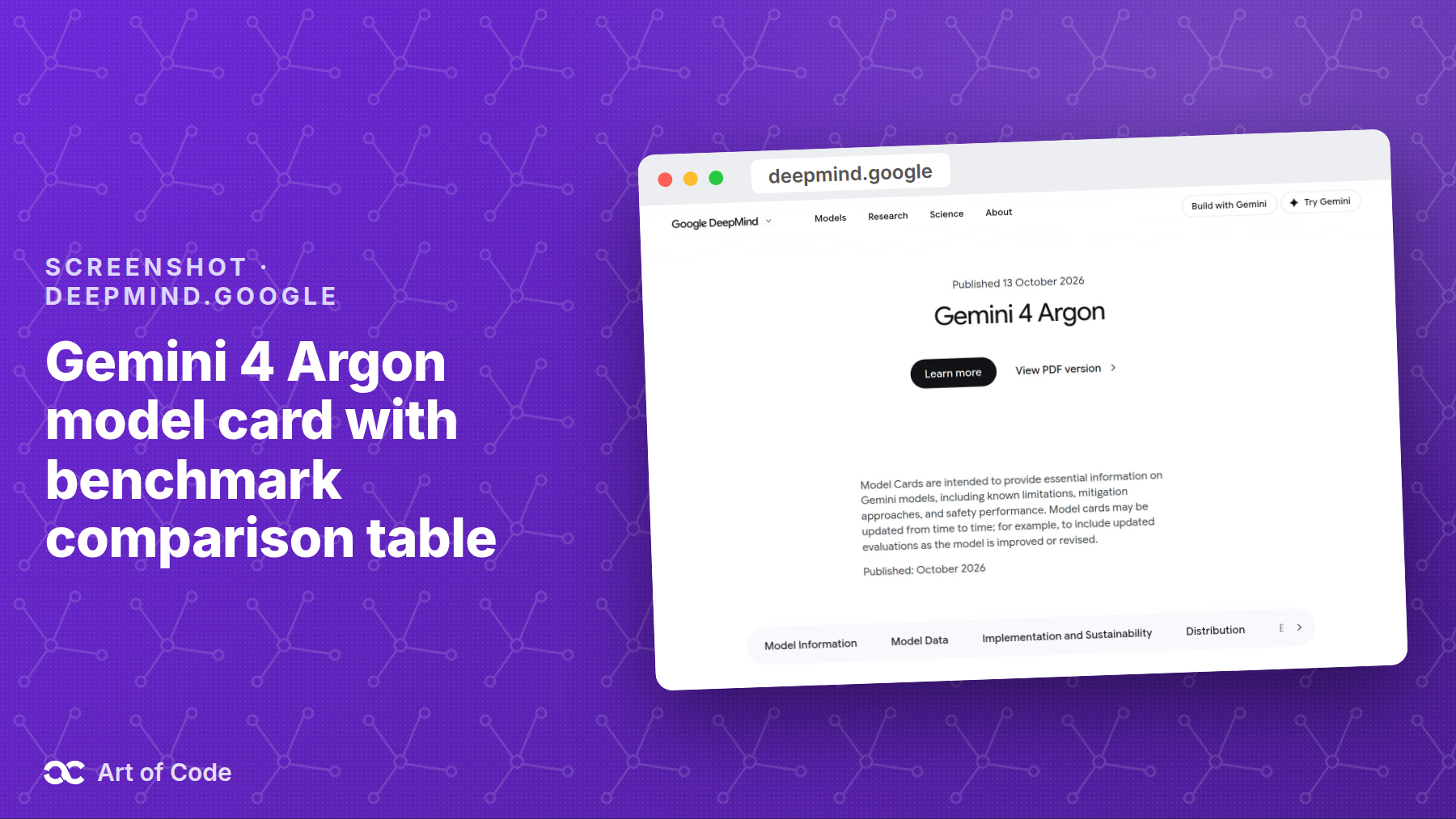
Google's launch post adds a few Argon-only claims. It reports 0.7% attack success on the Gray Swan indirect prompt injection benchmark across 15 adaptive attempts. It also says agentic code submissions in Google's Antigravity rose more than 35% inside Google. Treat both as vendor claims.
The practical reading: if your prompt is a whole codebase, a long contract or hours of video, Argon has the stronger evidence.
Where does Claude Opus 5.5 win?
Claude Opus 5.5 wins on terminal-based agentic coding. Google's own model card shows Opus 5.5 at 66.4% on Terminal-bench 4.0 against Argon's 57.4%, a gap of 9 points. It also leads on FrontierSWE v2, 62.3% to 55.0%.
The numbers that favour Opus 5.5:
| Benchmark | Opus 5.5 | Argon |
|---|---|---|
| Terminal-bench 4.0 | 66.4% | 57.4% |
| FrontierSWE v2 | 62.3% | 55.0% |
It is worth noticing who published these. Google put the table that shows its rival ahead on terminal work on its own model card. Let's Data Science reports that a DataCamp comparison also found Claude ahead on Terminal-Bench 4.0 and some terminal-heavy coding measures, though it gave no numeric scores.
Opus 5.5 is also positioned by Anthropic for "long-running agentic coding and knowledge work." It has a 128K token max output, and Anthropic says it is available on the Claude API, Amazon Bedrock, Microsoft Foundry and Google Cloud. If your company already buys through one of those clouds, that matters more than a benchmark point.
Is Gemini 4 Argon really better at coding?
Not across the board. Argon leads on DeepSWE v1.1 and Vibe Code Bench, and Opus 5.5 leads on Terminal-bench 4.0 and FrontierSWE v2. The honest answer is that the two split the coding benchmarks, and the winner depends on whether your task looks like a GitHub issue or a long terminal session.
Three cautions before you trust any of it:
- These are vendor-reported scores on Google's model card, run under Google's settings.
- Benchmarks measure a fixed task set. Your repo, your tests and your prompts are different.
- Effort and thinking settings change both quality and cost. A fair test uses the same budget on both.
For how the wider field stacks up, see our ranking of AI coding tools and the ChatGPT vs Claude vs Gemini vs Grok comparison.
Which should you pick, by situation?
Choose by workload, not by brand. The table maps common developer situations to the model with the stronger published evidence. It is a starting point for your own test, not a verdict.
| Your situation | Pick | Why |
|---|---|---|
| Autonomous agent running shell commands for hours | Opus 5.5 | Leads Terminal-bench 4.0, 66.4% vs 57.4% |
| Reading a huge repo or document in one prompt | Argon | Leads GraphWalks at 256K to 1M, 84.2% vs 66.8% |
| Video or multimodal analysis | Argon | Leads LVBench, 91.7% vs 83.7% |
| Fixing issues in a mature codebase | Argon, then test | Leads DeepSWE v1.1, 77.9% vs 74.2% |
| Business workflow automation | Argon, then test | Leads AutomationBench, 51.3% vs 42.5% |
| Budget is fixed and starts Dec 1 | Either | Same $4 / $20 list price |
| You need Bedrock, Foundry or one cloud bill | Opus 5.5 | Listed on Bedrock, Microsoft Foundry and Google Cloud |
| You want a free tier to experiment | Neither on Argon | Argon has no free tier |
Here is the process I would follow before locking in either one:
- Take 20 real tasks from your own repo.
- Run both models at the same effort setting.
- Log pass rate, output tokens and wall-clock time per task.
- Multiply tokens by the December 1 prices, not the launch prices.
- Pick the model with the lower cost per passing task.
A model that is cheaper per token but needs two attempts is not cheaper.
What about availability and access?
Argon became generally available on October 13, 2026 through the Gemini API and AI Studio. Google says Ultra subscribers get it in Antigravity, and Ultra and Pro subscribers get it in the Gemini app and AI Mode in Search. Cyber defenders can apply to the Fairwind Program for a version without cyber guardrails.
Opus 5.5 has been out since September 22, 2026, and Anthropic says it will not retire it sooner than September 22, 2027. That retirement floor is useful if you plan a year ahead.
For teams already on Gemini tooling, our walkthrough of optimizing agents with Gemini 4 Argon and ADK covers the setup side. If you are coming from an older Claude, the Claude Opus 4.8 review shows what changed before 5.5.
FAQ
Is Gemini 4 Argon cheaper than Claude Opus 5.5?
Only until November 30, 2026. Argon is $2 input and $10 output per million tokens during the introductory period. From December 1 it is $4 and $20, which matches Opus 5.5's list price exactly.
Which model has the bigger context window?
They tie at 1M tokens. The difference is that Argon's 1M limit is unified across input, thinking and output, while Anthropic lists Opus 5.5 as 1M context with a separate 128K max output.
Which is better for coding, Gemini 4 Argon or Claude Opus 5.5?
They split. Per Google's model card, Argon leads DeepSWE v1.1 and Vibe Code Bench. Opus 5.5 leads Terminal-bench 4.0 and FrontierSWE v2. Run both on your own tasks before choosing.
Can I use Gemini 4 Argon for free?
No. Google's pricing page says Argon is not available on the free tier. You need a paid Gemini API plan, or a Google AI subscription for the apps.
Run your own 20-task test this week, while Argon is still half price, then check free tools on Art of Code for the boring parts. If you are thinking about where this leaves your job, read will AI replace developers in 2026.
Written by Adithya Guttha, Founder of Art of Code.
Sign in to like and save posts.
Keep reading
Discussion
Comments (0)
Want to join the conversation?
Sign in to commentNo comments yet. Be the first to comment!