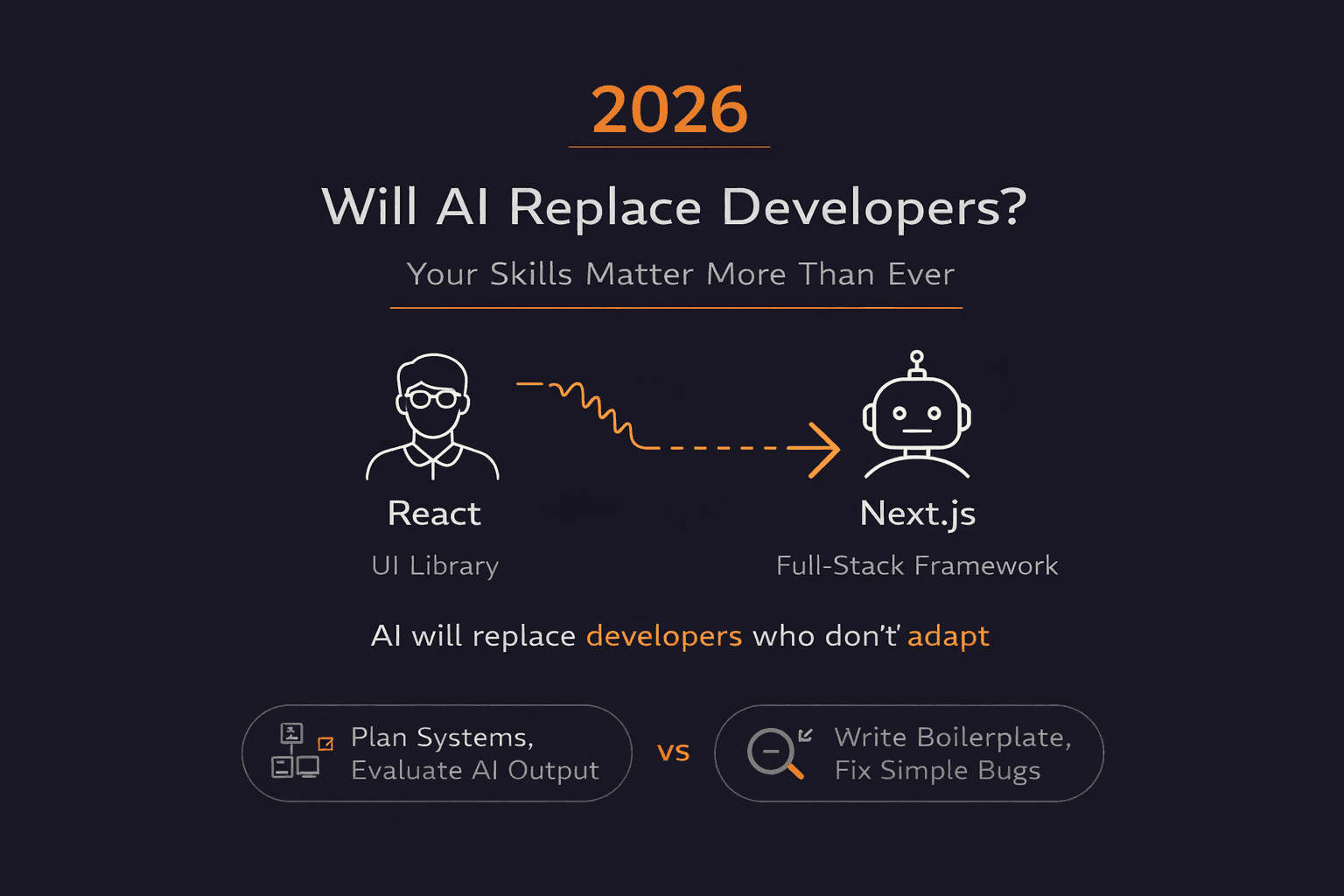
Will AI Replace Software Developers in 2026? Honest Answer
AI won't replace developers, but it will replace developers who don't use AI. Junior jobs are shrinking, senior roles changing. Here's how to adapt and future-proof your career.
Short answer: AI won't replace developers, but it will replace developers who don't use AI. The role is changing and less typing code, more designing systems and verifying AI output. Junior jobs are shrinking because AI handles entry-level tasks. Senior roles are growing because someone needs to architect, review, and fix what AI generates.
The software industry just hit one of those inflection points that only makes sense in hindsight.
Nobody actually knows what's going to happen
Let me be honest with you. I have no idea how the future will look for us developers. I don't know if Claude 6.9 or GPT-7 will actually replace me, despite what everyone keeps saying in YouTube comments. I don't know if AI will end up being just another tool that helps us move faster, or if it fundamentally changes what being a developer even means. What's more important is that I genuinely believe nobody knows how this will settle once the hype cycle burns off and the economic incentives become clear.
But here's what we do know. We're not in speculation territory anymore. We have actual data. Studies tracking labor adoption patterns show real changes happening right now. Companies introducing AI into engineering workflows are hiring fewer juniors while keeping senior hiring stable. This isn't a prediction and it's already happening. The question isn't "Will AI change software development?" It already has. The question is "How do we adapt?"
Addy Osmani spent years working on web performance and developer tooling at Google. He's known less for hype and more for translating emerging trends into practical implications for developers. When he shares his take on the future of software development, we should listen. So let's break down what the next two years actually look like for us, based on what people deep in the industry are seeing, not what AI companies want us to believe.
The shift nobody's talking about: AI compresses the distance between idea and execution
Here's the core change. Addy's argument isn't that AI replaces developers. It's that AI compresses the distance between idea and execution. The friction that used to justify large teams is shrinking because boilerplate setup and repetitive work can now be automated successfully by LLMs. Companies are realizing that productivity is no longer strictly linear with hiring, and that forces them to rethink what an engineering team should look like.
For decades, the story was simple. Software was eating the world, capital was cheap, and companies hired anyone who knew the difference between Java and JavaScript. Growth mattered more than efficiency, and the solution to any problem was to hire more engineers. But AI breaks that assumption. When a senior engineer assisted by AI can complete tasks that previously required multiple junior contributors, companies start questioning the need to expand the bottom of the pyramid.
This creates a dangerous feedback loop. Companies stop hiring entry-level roles, teams become smaller and more experienced over time, and from a short-term efficiency perspective, this looks rational. But from a long-term ecosystem perspective, it's a disaster. Every senior engineer was once a junior. If you break the pipeline, the industry eventually runs out of experienced builders and technical leaders. We're optimizing for the next quarter while destroying the next decade.
What's happening to junior developers right now
The traditional entry path into software development is collapsing. For decades, the career path was straightforward: learn the fundamentals, get hired into a junior role, gain experience through mentorship and mistakes, and gradually move up the ladder. AI weakens the economic logic that supported this pipeline, and early data confirms it. When companies introduce generative AI into engineering workflows, junior hiring declines while senior hiring remains relatively stable.
The brutal truth is that tasks junior developers used to handle these things like writing boilerplate, fixing simple bugs, implementing straightforward features from specs which are exactly the tasks AI tools excel at. From a company's perspective, why hire a junior who needs six months to become productive when you can give Claude or Cursor to a senior who becomes 3× more productive immediately? The math stops making sense.
But here's where it gets interesting. There's an alternative few people are discussing. If AI dramatically reduces the cost of building software, software might spread into industries that historically employed very few developers. Healthcare systems could automate workflows, manufacturing could embed custom tooling, agriculture could adopt data-driven automation. In that world, demand for developers actually increases rather than decreases. But the roles look very different. Entry-level developers become domain specialists who understand both software and a specific industry like healthcare tech, agricultural automation, manufacturing systems. The pure "I just learned to code from bootcamp" junior developer might be finished, but the "I understand healthcare and can build software for it" developer might be just getting started.
What AI can actually do right now (and what it can't)
Let's cut through the hype and be specific about what these tools actually do well and where they completely fall apart.
What AI Can Do vs What AI Can't Do
| AI Can Do | AI Can't Do |
|---|---|
| Write boilerplate code (CRUD operations, setup files) | Understand your specific business requirements |
| Generate working code from clear specifications | Design system architecture for scale |
| Debug syntax errors and common bugs | Make strategic technical decisions |
| Explain existing code | Understand why a system exists in the first place |
| Suggest common patterns and libraries | Know when to break best practices |
| Autocomplete code faster than typing | Reason about edge cases in production |
| Translate code between languages | Understand user needs and translate them to features |
| Write tests for existing functions | Prioritize what to build next |
| Optimize simple algorithms | Navigate office politics and get projects approved |
| Format and refactor code | Mentor junior developers |
The pattern is clear. AI handles implementation. Humans handle judgment. AI generates code. Humans decide what to build, why to build it, and whether the generated code actually solves the real problem.
The dangerous trust gap: 96% don't trust AI output, but only 48% verify it
Here's where things get scary. A recent study shows that 96% of engineers don't fully trust AI output. Yet only 48% consistently verify what they ship. Read that again. Almost every engineer recognizes that AI output can't be blindly trusted. Yet less than half actually check it before deploying to production.
This gap between awareness and behavior is the real risk, and I think it will get worse. When I'm using Claude or Cursor, my instinctive response to a problem is to keep prompting rather than think through the solution myself. This changes how skills form. Newer engineers encounter problems they never solve independently. They receive correct-looking solutions before developing the mental models that explain why those solutions work. The code functions, but it hides inefficiencies, security flaws, or architectural issues that only surface under load or in production.
The dividing line is becoming clear. Developers who rely entirely on AI risk losing the ability to reason independently about code. They become validators, not creators. Meanwhile, developers who use AI while maintaining strong fundamentals gain massive leverage. They move faster while still understanding what's happening under the hood. The winner isn't the developer who refuses to use AI out of pride, and it's not the developer who blindly ships whatever ChatGPT generates. The winner is the developer who uses AI as a force multiplier while staying technically sharp.
The role is changing: from coding to orchestration
The definition of "software developer" is beginning to shift. Coding itself is no longer the sole center of value creation. The role can evolve in two opposite directions, and which one wins matters enormously.
In the pessimistic version, development becomes oversight. AI systems produce code, and developers review it for correctness, compliance, and safety. The creative aspect of programming diminishes. Work becomes reactive rather than generative. Engineers spend more time validating outputs than designing solutions. There are already signals of this transition—engineers report increased time reviewing AI-generated pull requests, managing automated pipelines, and handling edge cases introduced by automated systems. Programming starts to feel closer to quality assurance than creation. A few days ago, TechCrunch reported that Spotify's best developers haven't written a line of code since December thanks to AI. The article was met with skepticism on Reddit, but let's not lie to ourselves. This is the direction many tech companies want to move.
The alternative trajectory is more optimistic. As AI systems handle implementation details, developers move upward in abstraction. They define system architecture, decide how components interact, and orchestrate multiple AI and software systems into coherent products. They become conductors, not musicians. This is actually a higher-value role—architectural decisions have more leverage than implementation speed—but it requires different skills. You need to understand systems deeply enough to know when AI suggestions make sense and when they'll create problems six months down the line.
Why specialists are in trouble (and generalists aren't much better)
Rapid technological change exposes the weakness of narrow specialization. Historically, deep expertise in a single technology could sustain an entire career. AI shortens the lifespan of such niches by reducing the effort required to operate within them. Tasks that once justified specialization like UI building, boilerplate API construction, routine database optimization are increasingly be handled by tools. Specialists who operate only at that layer risk seeing their value compressed.
The industry has seen this pattern repeatedly, from Flash developers to legacy framework experts. The difference now is speed. AI accelerates how quickly a niche becomes commoditized. What used to take a decade now takes two years. But pure generalists struggle too, because shallow knowledge fails under complexity. Saying "I know a little bit about everything" won't save you when production goes down at 3 AM.
The emerging pattern favors T-shaped engineers that means individuals with deep expertise in one or two areas combined with broad competence across adjacent domains. These developers understand enough about multiple layers to make coherent decisions without becoming blocked by specialization boundaries. They can architect a system, write the critical parts, review AI-generated code across the stack, and debug when things break. That combination of depth and breadth is what survives.
How to future-proof your career (actionable steps)
Alright, enough doom and gloom. What do you actually do about this? Here's what I'm doing, and what I recommend to students at Art of Code.
First, learn fundamentals deeply, not just syntax. AI can generate code, but it can't think through trade-offs. Study data structures and algorithms not to pass interviews, but to understand why one approach scales and another doesn't. Learn how databases actually work under the hood. Understand networking, not just how to call an API. These fundamentals don't expire because they're not tied to specific tools.
Second, use AI daily, but verify everything it gives you. Make it part of your workflow, but never trust it blindly. When Claude generates a function, understand what it's doing. When Cursor autocompletes your code, make sure you agree with the implementation. Treat AI output as a first draft, not a finished solution. The developers who win are the ones who move 10× faster with AI while still understanding every line.
Third, become T-shaped instead of specialized. Pick one or two areas to go deep and maybe it's systems design, maybe it's React and frontend performance, maybe it's database optimization. Go so deep in those areas that you understand principles, not just patterns. Then develop working knowledge across the stack. You don't need to be an expert in everything, but you need to know enough to have intelligent conversations and make decisions.
Fourth, develop skills AI can't replicate. System architecture, understanding business requirements, translating user needs into technical specifications, mentoring other developers, making trade-off decisions under constraints. These are judgment calls that require context AI doesn't have. Focus on work that requires you to understand why, not just what.
Fifth, if you're a student or junior developer, find ways to gain real production experience fast. The old "learn on the job over two years" path is closing. You need to be productive quickly. Build real projects that have users. Contribute to open source. Do freelance work where you're responsible for the entire system, not just implementing tickets. Get comfortable with the full lifecycle like requirements, implementation, deployment, debugging production issues which is actually because that's what separates developers AI can't replace from developers it can.
Want to build real projects while learning these fundamentals?
Try Anything →. Use it to ship products quickly, learn by building, and develop the full-stack thinking that survives AI automation. Then understand why it works.
Our take at Art of Code
We're not teaching students to compete with AI. We're teaching them to use AI while staying technically excellent. That means learning fundamentals first like data structures, algorithms, how systems actually work. Then learning AI tools as force multipliers, not crutches. Building real projects that solve real problems, not just following tutorials. And developing the judgment to know when AI-generated code is good enough and when it needs to be rewritten.
The developers who thrive in the next two years won't be the ones who resist AI or the ones who blindly adopt it. They'll be the ones who understand both code and systems deeply enough to know when to use AI and when to override it. The role is changing, but it's not disappearing. It's becoming more valuable if you adapt, and less valuable if you don't.
5 FAQs
Q: Should I still learn to code in 2026 with AI getting so good?
A: Yes. Learning to code is more important than ever, but the reason changed. You're not learning to type syntax because AI does that. You're learning to think in systems, understand trade-offs, and architect solutions. The code is the output. The thinking is the skill. If you can't think through a problem, AI can't help you.
Q: Will junior developer jobs exist in 2 years?
A: Fewer will exist, and they'll look different. Traditional "junior writes boilerplate for 6 months" roles are shrinking. But roles for "junior who understands healthcare + can code" or "junior who ships products fast using AI" are growing. The key is becoming productive quickly and bringing unique context (domain knowledge, full-stack ability) that pure code generation can't replace.
Q: How do I compete with developers who use AI if I don't?
A: You can't. Not using AI in 2026 is like not using Google in 2006. It's a productivity tool, not a replacement. The question isn't "Should I use AI?" It's "How do I use AI while staying technically sharp?" Use it to move faster, but verify everything. Understand what it generates. Don't let it atrophy your skills.
Q: What programming skills are most AI-proof?
A: System architecture, understanding business requirements, debugging production issues, performance optimization at scale, security thinking, and mentoring other developers. Anything that requires deep context, judgment calls, or understanding why (not just what) to build. AI generates code. Humans decide what to build and whether it actually solves the problem.
The bottom line
AI won't replace developers. It will replace developers who don't adapt.
The role is changing from "write code" to "design systems and verify AI output." Junior positions are shrinking because AI handles entry-level tasks. Senior positions are growing because someone needs to architect, review, and fix what AI generates.
Skills that matter: fundamentals (so you can evaluate AI output), system thinking (so you know what to build), and judgment (so you know when AI is right and when it's dangerously wrong).
Skills that don't matter anymore: typing code fast, memorizing syntax, writing boilerplate by hand.
If you're learning to code right now: go deeper on fundamentals, use AI daily but verify everything, build real projects with real users, and develop skills AI can't replicate (architecture, product thinking, domain expertise).
If you're an experienced developer: double down on system design, architectural thinking, and mentorship. Let AI handle implementation. You focus on the decisions that matter.
The future isn't "AI or developers." It's "AI and developers who know how to use it."
Which side of that equation are you on?
How are you adapting to AI as a developer? Drop a comment.
We read them all and use them to shape our curriculum at Art of Code.
Written by Curious Adithya for Art of Code