Is Kubernetes Dead? What Gitpod and 37signals Show
Gitpod left Kubernetes for one workload and called it "a fine choice" for apps. 37signals reported saving almost $2M a year off the cloud. Here is what that means.

6 min read · Last updated: October 25, 2026
No, Kubernetes is not dead. Gitpod left it for one narrow workload, cloud development environments, and said Kubernetes is still "a fine choice" for application workloads. 37signals left the public cloud, not a specific orchestrator. Both stories are about fit and cost, and neither proves Kubernetes is finished.
Came here from Instagram, LinkedIn, X or YouTube? Here is the full source list you came for. Everything below is built from these, nothing else.
The Gitpod decision
- We're leaving Kubernetes, by Christian Weichel and Alejandro de Brito Fontes, Oct 31, 2024 (Gitpod, now Ona)
The 37signals numbers
The post that prompted this
- Kubernetes Is Officially Dead. Why Are We Still Paying For It?, AWS in Plain English (the page blocked my fetch, so I used it for the angle only, not for any fact)
Key takeaways
- Gitpod ran Kubernetes for about 6 years and still wrote that it is "a fine choice" for application workloads.
- Its reason for leaving was specific: development environments are stateful, interactive and need root-level permissions.
- 37signals reported saving almost $2 million in its first clean year off the cloud.
- Its five-year savings projection rose from $7 million to well over $10 million.
- 37signals' cloud bill before the exit was $3,201,564. The remaining bill is about $1.3 million, almost all S3.
- The headline "Kubernetes is dead" is not supported by either company's own words.
What did Gitpod actually do?
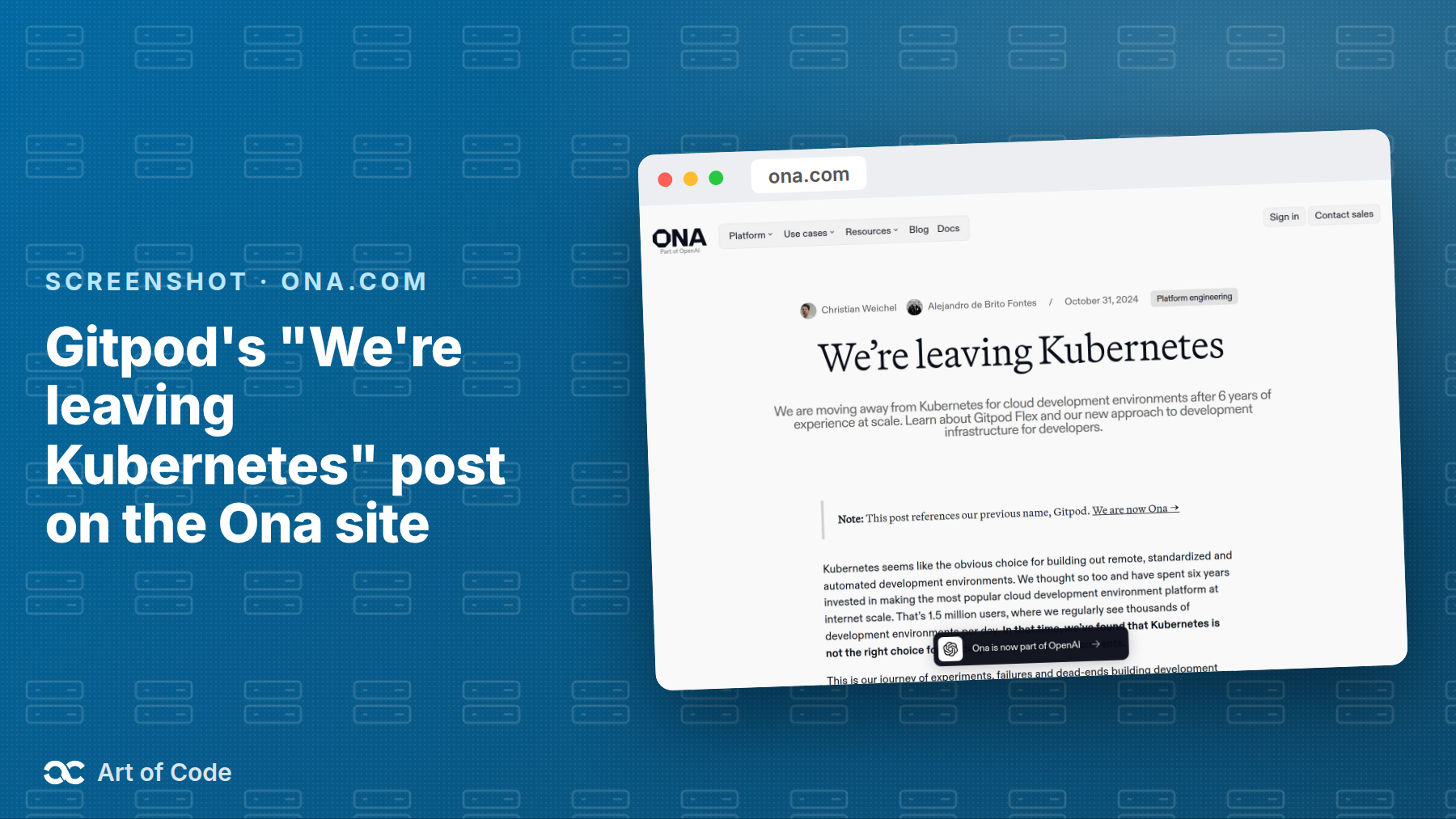
On October 31, 2024, Gitpod engineers Christian Weichel and Alejandro de Brito Fontes published "We're leaving Kubernetes". After six years running cloud development environments for about 1.5 million users, they concluded Kubernetes is the wrong base for that job. They built a replacement called Gitpod Flex instead.
Flex took from January 2024 to October 2024 to build. It keeps Kubernetes-style ideas, like control loops and declarative APIs, but uses a simpler design made for development environments, with zero-trust security. It can be self-hosted in under three minutes.
What did 37signals actually do?
37signals, the company behind Basecamp and HEY, moved seven cloud apps off AWS in summer 2023 and onto Dell hardware it owns. According to The Register on October 21, 2024, it spent about $700,000 on that hardware and recouped the cost during 2023.
The Register reports the cloud bill fell from $3,201,564 to about $1.3 million. Nearly all of the remainder is AWS S3 storage, tied to a four-year contract that ends in summer 2025. CTO David Heinemeier Hansson said the company needed no extra staff after the move.
Why does this matter to a developer?
The lesson is that infrastructure choices are workload decisions, not fashion. Gitpod's team wrote: "You are not choosing Kubernetes vs something else, you are choosing a system because it improves the experience for the teams you support." A viral headline hides that distinction, and it is the part you can use.
Two patterns are worth separating:
- Wrong tool for the workload. Gitpod's problem was the shape of the job, not the quality of Kubernetes.
- Wrong place to run it. 37signals' problem was the bill for renting compute and storage at steady, predictable load.
If you read both stories as "Kubernetes bad", you will make the wrong move in both cases.
Is Kubernetes dead?
No. The strongest evidence against the headline is Gitpod's own text. The authors wrote: "This is not a story of whether or not to use Kubernetes for production workloads." They add that for application workloads, Kubernetes "continues to be a fine choice". A company that left Kubernetes says it is not dead.
The 37signals sources do not discuss Kubernetes at all. They discuss owning servers versus renting them. Treating that as a Kubernetes verdict is a leap the sources do not make.
Why did Gitpod say Kubernetes did not fit?
Gitpod said Kubernetes fits controlled application workloads, not unruly development environments. Its engineers listed noisy-neighbour CPU and memory contention, persistent volume claims that slowed workspace startup, image-pull overhead, networking complexity at scale, and security workarounds for user namespaces, FUSE and Docker.
In their words: "Fundamentally, Kubernetes is built to run well controlled application workloads, not unruly development environments." Most web apps and APIs look nothing like that. A typical stateless service does not need root access or a persistent disk tied to a node.
| Workload trait | Gitpod dev environments | Typical web API |
|---|---|---|
| State | Heavy, per user | Usually external database |
| Permissions | Broad, including root | Locked down |
| Resource use | Bursty, unpredictable | Mostly steady |
| Startup time | Must feel instant | Rolling deploys tolerate delay |
| Fit for Kubernetes (per Gitpod) | Poor | "A fine choice" |
How much did 37signals really save?
According to The Register's October 21, 2024 report, 37signals saved almost $2 million per year in its first clean year, 2024. It raised its five-year projection from $7 million to "well over $10 million". Hansson said the real savings were "even better than originally estimated".
The same article lists the caveats, and you should keep them:
- The figures are the company's own claims, not independently verified.
- Hansson said the comparison is "never fully apples-to-apples".
- Savings were helped by fitting the new hardware into existing datacenter racks and power limits.
- The S3 replacement, planned at 18 PB across two datacenters, was an estimate with no dollar figure.
- An analyst told The Register that companies repatriating from public cloud are a "single digit percentage" of the market.
What changes in practice?
The practical change is how you justify infrastructure. "Everyone uses it" stops being a reason, and "this is what the workload needs" becomes the reason. For most teams that changes the questions you ask, not the tool you pick.
| If your workload is... | Ask this first |
|---|---|
| A few stateless services | Do you need an orchestrator, or would plain containers on a managed host do? |
| Stateful, interactive, root-heavy | Is Kubernetes fighting your design, as it did for Gitpod? |
| Steady, predictable, large bills | Would owning the hardware beat renting, as for 37signals? |
| Spiky or unknown demand | Does elastic cloud capacity still earn its price? |
Note that 37signals had a very large, steady bill and a team able to run hardware. A small team with spiky traffic is in a different position. If you are new to containers, start with what Docker is and how it works before deciding on an orchestrator.
What should you do this week?
- Write down your real monthly infrastructure bill, split into compute, storage and data transfer.
- List your workloads and mark each as stateless, stateful or interactive.
- Find the one workload that fights your platform, such as slow startups, volume problems or permission hacks.
- Check your storage contracts. 37signals' largest remaining cost was a multi-year S3 commitment.
- Do not migrate anything yet. Make the case on paper first, with numbers.
This is also the kind of reasoning that system design interviews test. See why most developers fail system design interviews, and why coding fundamentals still matter when tools and headlines keep changing.
FAQ
Is Kubernetes dead in 2026?
No source I opened says so. Gitpod's authors wrote that Kubernetes "continues to be a fine choice" for application workloads. Their exit covered one workload, development environments. The headline overstates both stories.
Why did Gitpod leave Kubernetes?
Gitpod found Kubernetes a poor base for development environments, which are stateful, interactive and need broad permissions. It cited CPU and memory contention, slow volume handling, image pulls and security workarounds. It built Gitpod Flex, which shipped in October 2024.
How much did 37signals save by leaving the cloud?
The Register reported on October 21, 2024 that 37signals saved almost $2 million in its first clean year and projected well over $10 million over five years. Those are the company's own numbers and were not independently verified.
Should small teams leave Kubernetes or the cloud?
Not because of these stories. Gitpod's case was about workload shape, and 37signals' case was about a large, steady bill. Measure your own workloads and costs first, then decide.
Take one hour this week to cost out your infrastructure, and try the free tools on Art of Code while you do it. For more on weighing hype against evidence, read AI is not ready: why we're being sold an unfinished product.
Written by Adithya Guttha, Founder of Art of Code.
Sign in to like and save posts.
Keep reading

Discussion
Comments (0)
Want to join the conversation?
Sign in to commentNo comments yet. Be the first to comment!