Neural Chip Decodes Interactions Between Brain Regions
EPFL's LogSync chip reads how brain regions talk to each other, classifies cognitive and emotional states, and does it on under 200 microwatts. Here is how it works.

6 min read · Last updated: October 24, 2026
A neural chip that decodes interactions between brain regions is an implant that listens to several areas of the brain at once and measures how in sync they are. EPFL's LogSync chip does this in about 4x2 mm on under 200 microwatts, then uses machine learning to classify cognitive and emotional states.
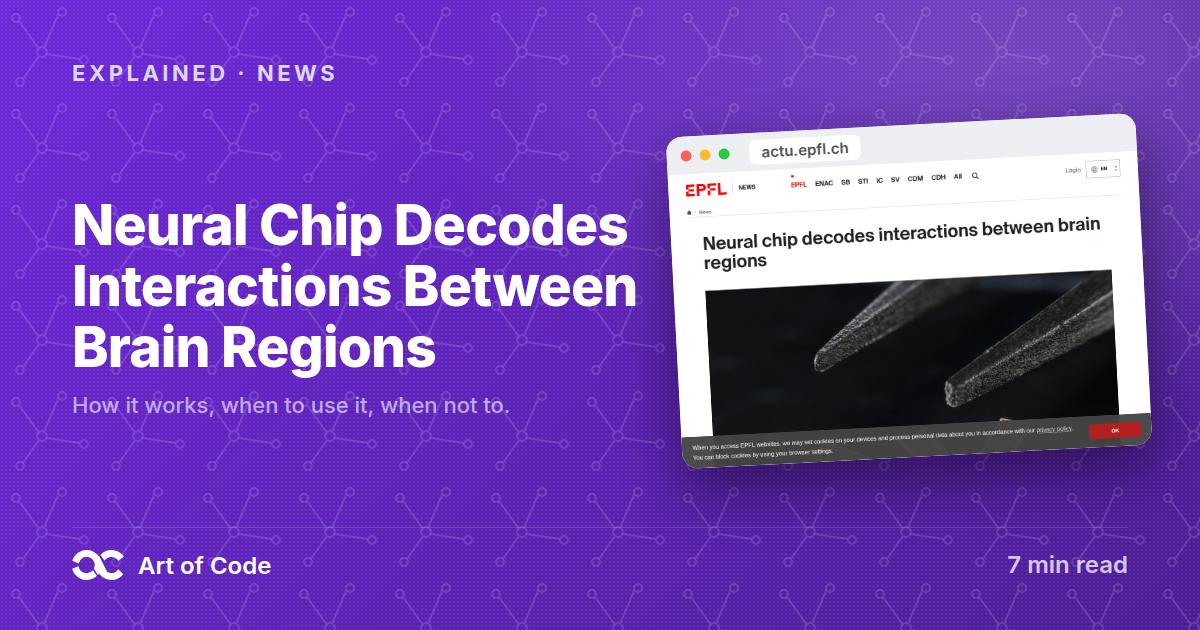
Came here from Instagram, LinkedIn, X or YouTube? Here is the full source list you came for. Everything below is built from these, nothing else.
The announcement
The papers it cites
- LogSync: A Low-Power Logarithmic SoC for Cross-Regional Synchrony Extraction and Adaptive Psychiatric State Classification, IEEE Journal of Solid-State Circuits, September 2026
- RECTOR: Masked Region-Channel-Temporal Modeling for Affective and Cognitive Representation Learning, ICML 2026
- A 32-Channel 196-μW Logarithmic SoC for Brain Network Connectivity Extraction and Adaptive Psychiatric Symptom Classification, VLSI Technology and Circuits Symposium, Kyoto, 2025
This one is a hardware story with a software heart. A team at EPFL, the Swiss federal technical university, put a classifier and a signal-processing pipeline on a chip small enough to implant. I will walk you through the idea, the pipeline, and where it does and does not apply.
Key takeaways
- LogSync is an implantable system-on-chip of about 4x2 mm.
- Its power draw stays under 200 microwatts, which EPFL calls a fraction of what many implantable neural-interface systems need.
- It extracts two kinds of biomarkers: oscillation strength and synchrony between regions.
- It was tested on human recordings from earlier psychiatric experiments and in rats at the University of Minnesota.
- The work sits inside a CHF 6.6 million grant from the US National Institute of Mental Health.
- The source reports validation on recordings and rats. It does not report a human implant trial.
What does it mean to decode interactions between brain regions?
It means measuring how different brain areas coordinate, not just how active each one is. The idea comes from research suggesting psychiatric disorders arise more from disrupted communication between regions than from a fault in any single region, according to Mahsa Shoaran of EPFL, who leads the Integrated Neurotechnologies Lab.
Here is a comparison. Imagine judging a team meeting by listening to one person. You learn how loud that person is. You learn nothing about whether the group is in agreement, talking over each other, or silent.
Most adaptive brain stimulation works like that. EPFL says that even among closed-loop systems, many rely on signals from a single brain region. LogSync listens to the whole room and scores how in sync the speakers are.
What is deep brain stimulation, and why does it need this?
Deep brain stimulation (DBS) delivers electrical pulses to specific brain areas through an implant to modulate neural activity. EPFL notes it is already widely used for movement disorders such as Parkinson's disease, and researchers are exploring it for major depression, post-traumatic stress disorder and obsessive-compulsive disorder.
The weak point is how the pulses are timed. Most existing DBS systems run "open loop", meaning stimulation follows predefined settings rather than adapting to what the brain is doing.
| Approach | What drives stimulation | Limitation named by EPFL |
|---|---|---|
| Open loop | Predefined settings | Does not adapt to brain activity |
| Closed loop, single region | Signals from one brain region | Misses information spread across networks |
| LogSync (network level) | Synchrony and oscillations across regions | Validated so far on recordings and rats |
How does the LogSync chip work, step by step?
LogSync records brain activity, turns it into network-level biomarkers, classifies the brain state with machine learning, and generates a stimulation trigger when a target state is detected. EPFL describes it as a low-power, implantable neural system-on-chip, all on one piece of silicon.
- Record. The chip records brain activity from the implanted channels. The 2025 conference version of the design was a 32-channel chip drawing 196 microwatts.
- Extract oscillation strength. It computes how strong the brain waves (oscillations) are.
- Extract synchrony. It computes how synchronized the signals are between different brain regions.
- Classify. A machine-learning algorithm analyzes these network-level biomarkers to tell cognitive and emotional states apart.
- Trigger. When a specific state is detected, the chip generates a stimulation trigger. In the rat experiments, triggers were generated at predefined phases of brain activity.
The point of steps 2 and 3 is that the classifier never sees raw signals. It sees a small set of numbers that describe the network, which is cheaper to process.
How does it run on under 200 microwatts?
The team co-designed the algorithms and the hardware together around the limits of an implant. Shoaran says this let them do network-level processing and decoding on a single chip while keeping power under 200 microwatts. A second ingredient is the use of logarithmic computations, which EPFL says simplify the operations needed for brain-network analysis and real-time biomarker extraction and decoding.
Shoaran identifies the power budget as the major challenge. An implant cannot run a laptop-class model, so the model has to be shaped to fit the chip, not the other way around.
EPFL's announcement does not break down where the savings come from, so I will not guess at the circuit details. The paper in the IEEE Journal of Solid-State Circuits is the place for that.
What did the researchers actually test?
They ran two kinds of tests, and it matters to keep them apart.
| Test | What it covered | Result reported |
|---|---|---|
| Human recordings, dataset 1 | Changes in cognitive engagement during a mental task | Algorithm distinguished states from neural recordings alone |
| Human recordings, dataset 2 | Emotional arousal while viewing video clips | Algorithm distinguished states from neural recordings alone |
| Rats, University of Minnesota | Live implant tracking oscillations | Chip generated triggers at predefined phases |
The human data came from previous psychiatric experiments. EPFL does not describe a live human implant in this announcement.
When does this approach make sense, and when does it not?
It fits when the signal you need is spread across regions, and when power is the hard limit. EPFL says the capability to extract network biomarkers and trigger precisely timed stimulation applies beyond psychiatry: adaptive DBS for movement disorders, closed-loop non-invasive stimulation, and emerging focused-ultrasound interfaces.
It is a weaker fit when a single region already carries the signal you need, or when you want a model that learns its own features. EPFL notes the lab is separately building machine-learning methods that learn directly from neural recordings instead of predefined biomarkers. Their ICML 2026 work uses self-supervised learning to capture neural activity across regions, channels and time. That line of work is also being taken forward through Infera Neuro, an EPFL spin-off co-founded by Shoaran.
And the honest limit: LogSync's initial validation focused on psychiatric applications, using recordings and rats. Treat it as a hardware milestone, not a therapy.
What does the pipeline look like in code?
This is an illustrative sketch of the idea, not LogSync's actual implementation. It shows why network-level features are different from single-region ones.
# Illustrative only. Not EPFL's code.
def process_window(channels_by_region):
    features = []
    for region, signal in channels_by_region.items():
        features.append(oscillation_strength(signal))   # per region

    for a, b in region_pairs(channels_by_region):
        features.append(synchrony(a, b))                # between regions

    state = classifier(features)                        # e.g. low vs high arousal
    if state == TARGET_STATE:
        return stimulation_trigger()
    return None
A single-region system stops after the first loop. The second loop, the pairwise synchrony, is the network-level part.
Who is behind it, and who paid for it?
The paper's lead author is D. Alex, and the lab is Shoaran's Integrated Neurotechnologies Lab at EPFL's Geneva campus. The work was developed under a CHF 6.6 million grant from the US National Institute of Mental Health to build implantable systems that measure and control oscillatory brain networks for severe psychiatric illnesses, particularly mood and anxiety disorders. Funding also lists a Swiss SERI-funded ERC Starting Grant. It builds on the lab's earlier work on brain-to-text decoding and closed-loop neuromodulation.
FAQ
What is LogSync?
LogSync is a low-power, implantable neural system-on-chip from EPFL. It records brain activity, extracts oscillation and cross-region synchrony biomarkers, classifies cognitive and emotional states with machine learning, and generates stimulation triggers. The chip measures about 4x2 mm.
How much power does the chip use?
EPFL says under 200 microwatts, a fraction of what many implantable neural-interface systems need. The 2025 conference version of the design was a 32-channel chip rated at 196 microwatts.
Has it been tested in people?
The announcement describes tests on human brain recordings from previous psychiatric experiments and live tests in rats at the University of Minnesota. It does not describe a human implant trial.
Is it only for psychiatric conditions?
No. Validation focused on psychiatry, but EPFL says the approach applies to adaptive DBS for movement disorders, closed-loop non-invasive stimulation and focused-ultrasound interfaces.
Where to go next
If the machine-learning side interests you, start with our explainer on neural networks, then read AI is not ready: why we're being sold an unfinished product for a sober look at hype. For the career angle, see 5 brutal shifts in software engineering in 2026. Then try the free tools on Art of Code or browse open developer jobs.
Written by Adithya Guttha, Founder of Art of Code.
Sign in to like and save posts.
Keep reading

Discussion
Comments (0)
Want to join the conversation?
Sign in to commentNo comments yet. Be the first to comment!