DeepSeek V4 Flash Pricing: New Rates and the V4 Pro Reroute
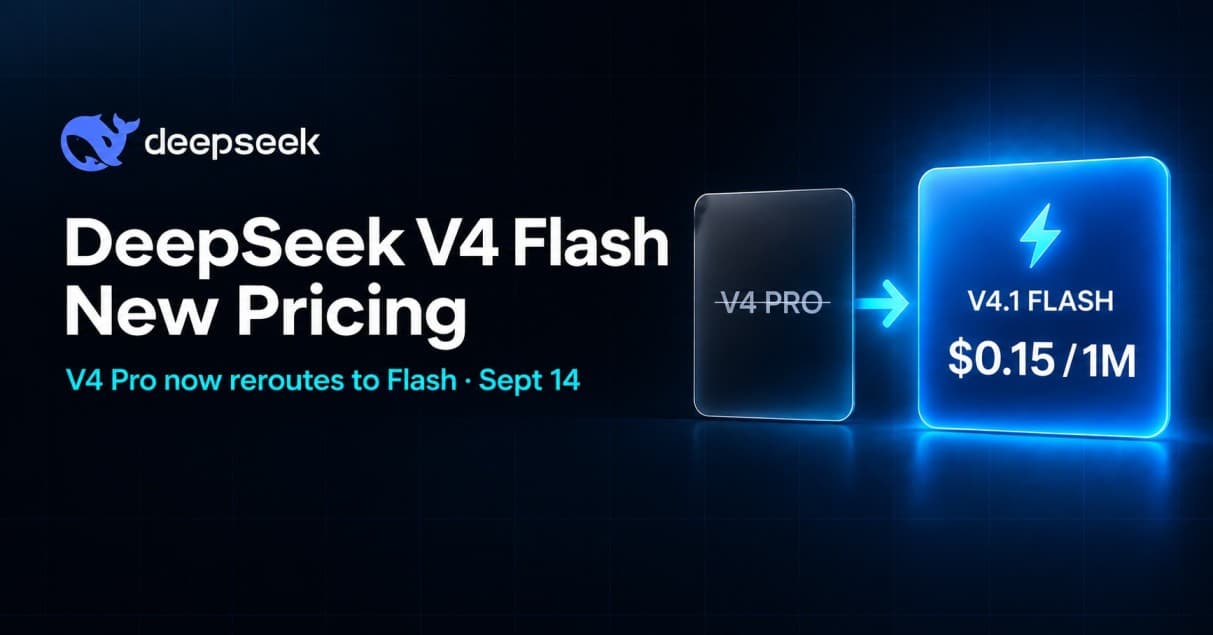
V4.1 Flash cut DeepSeek's input prices, but output is most of a cached bill and fell only 9%. V4 Pro users get the real cut on Sept 14.
DeepSeek V4 Flash pricing changed on September 10, 2026, when V4.1 Flash replaced V4 Flash on the API. Off-peak rates are now $0.15 per million input tokens, $0.003 per million cached tokens and $0.60 per million output tokens. Peak hours cost double.
The second change lands at 04:00 UTC on Monday, September 14. From then, every deepseek-v4-pro request runs on V4.1 Flash and bills at Flash rates.
Existing Flash users get a smaller cut than the input price suggests, because the line that dominates a cached bill barely moved.
TL;DR
- V4.1 Flash (model
deepseek-flash), off-peak: $0.003 cache hit, $0.15 cache miss, $0.60 output per million tokens. Peak hours double all three. - From 04:00 UTC on September 14 (09:30 IST), DeepSeek's API serves
deepseek-v4-prorequests with V4.1 Flash at Flash rates, until V4.1 Pro ships. - At an 80% cache-hit rate, output is 79% of a Flash bill. Input fell 35% but output fell 9%, so that bill drops 16%.
- V4 Pro users on the same workload go from $54.56 to $15.24 a month. On DeepSeek's own benchmarks, V4.1 Flash is better at agentic coding and slightly worse on GPQA Diamond and HLE.
- V4 Pro is still available from third-party hosts, from about 3.8x the rerouted price.
What is the new DeepSeek V4 Flash pricing?
V4.1 Flash went live on September 10, 2026 as deepseek-flash, with new rates from 04:00 UTC that day. DeepSeek's release note says the old deepseek-v4-flash and deepseek-v4-flash-vision-exp names "temporarily route" to V4.1 Flash, so rename them.
| Per 1M tokens | Off-peak | Peak |
|---|---|---|
| Input, cache hit | $0.003 | $0.006 |
| Input, cache miss | $0.15 | $0.30 |
| Output | $0.60 | $1.20 |
Source: DeepSeek's API pricing page, checked September 11, 2026. Peak hours are 01:00-04:00 and 06:00-10:00 UTC, Monday to Friday.
If a pricing page still shows V4 Flash at $0.22 input and $0.66 output, it predates September 10. On September 11, aipricing.guru (marked "Last updated 2026-09-11") and devtk.ai (marked "Price Verified 2026-08-17") both still did.
The model has a 1M token context window, accepts up to 384K output tokens, and supports vision, which DeepSeek lists for deepseek-flash only. Weights are on Hugging Face under an MIT license.
Caching is automatic, and a cache hit costs 2% of a cache miss. The pricing page lists no cache write fee, unlike Claude, where a cache write costs 1.25x base input even after the Fable 5.1 read cut.
What happens to deepseek-v4-pro on September 14?
From 12:00 Beijing time on Monday, September 14, DeepSeek routes every deepseek-v4-pro request to V4.1 Flash and bills it at the V4.1 Flash price. That is 04:00 UTC, 09:30 IST, and 21:00 on Sunday in San Francisco.
DeepSeek says this lasts "until V4.1 Pro is released in the future" and gives no date. Your code keeps calling the same model name and gets a different model back.
V4 Pro has 1.6T parameters with 49B active per token. V4.1 Flash has a 552B parameter backbone that activates 8B parameters per token while reading input and 16B while generating. Both figures come from the Hugging Face model cards.
| Per 1M tokens, off-peak | V4 Pro until Sunday | From Sept 14 | Change |
|---|---|---|---|
| Input, cache hit | $0.022 | $0.003 | -86.4% |
| Input, cache miss | $0.66 | $0.15 | -77.3% |
| Output | $1.98 | $0.60 | -69.7% |
Peak rates fall by the same percentages. 04:00 UTC on Monday is also the minute the first peak window closes, so the first rerouted calls bill off-peak. The next peak window opens at 06:00 UTC.
DeepSeek V4 Flash vs Pro: is the reroute a downgrade?
DeepSeek's release note claims V4.1 Flash posts "benchmark results ahead of flagship models, including DeepSeek-V4-Pro." The model card backs part of that. Here are the two DeepSeek columns from its instruct benchmark table, run at the card's maximum reasoning effort:
| Benchmark | V4 Pro | V4.1 Flash |
|---|---|---|
| GPQA Diamond | 92.4 | 90.9 |
| HLE | 42.7† | 36.8 (39.1†) |
| Codeforces rating | 3348 | 3471 |
| MathArena Apex | 65.3 | 65.6 |
| Terminal-Bench 2.1 | 87.9 | 90.6 |
| Terminal-Bench 3.0 | 11.8 | 30.0 |
| Terminal-Bench 4.0 | 12.4 | 31.2 |
| DeepSWE v1.1 | 62.7 | 74.2 |
The † marks are the card's own. Compared like for like, HLE is 42.7 against 39.1.
For coding agents, that reads as an upgrade. V4.1 Flash more than doubles V4 Pro on Terminal-Bench 3.0 and 4.0 and resolves 11.5 points more on DeepSWE. V4 Pro keeps a small lead on GPQA Diamond and HLE, the two knowledge and reasoning tests.
Every number above is vendor-reported. The same table puts Claude Opus 5 at 43.3 and 51.8 on Terminal-Bench 3.0 and 4.0, so V4.1 Flash is not the strongest agent model on the chart. It is by far the cheapest one near the top.
How much cheaper is V4.1 Flash than V4 Flash?
The answer depends on how far back you look. DeepSeek raised prices on August 16 and introduced peak pricing, which we broke down in our analysis of the August DeepSeek price increase. That post's Flash table has been out of date since September 10.
| Per 1M tokens, off-peak | Before Aug 16 | Aug 16 | Sept 10 (Pro: Sept 14) |
|---|---|---|---|
| Flash cache hit | $0.0028 | $0.007 | $0.003 |
| Flash cache miss | $0.14 | $0.22 | $0.15 |
| Flash output | $0.28 | $0.66 | $0.60 |
| Pro cache hit | $0.003625 | $0.022 | $0.003 |
| Pro cache miss | $0.435 | $0.66 | $0.15 |
| Pro output | $0.87 | $1.98 | $0.60 |
The two older columns are the rates DeepSeek listed at the time, as recorded in our August 16 post. DeepSeek's live page now shows current rates only, so treat those two columns as our record rather than a vendor source.
On Flash, input rose 57% in August and has now come almost all the way back: $0.15 is 7% above its July price. Output rose 136% in August and has come down only 9% since. It is still 2.14x its July price.
Which part of a DeepSeek bill actually matters?
With cache hits at $0.003 per million, a workload that caches well pays very little for input. Most of the money goes to output.
We modelled a month of 100M input tokens and 20M output tokens, all off-peak, at two cache-hit rates. 0% is one-shot calls with no shared prefix. 80% is an agent that re-reads a long context on every turn.
| Model and rates | 0% cache hits | 80% cache hits |
|---|---|---|
| V4 Flash, before Aug 16 | $19.60 | $8.62 |
| V4 Flash, Aug 16 | $35.20 | $18.16 |
| V4.1 Flash, Sept 10 | $27.00 | $15.24 |
| V4 Pro, Aug 16 to Sept 13 | $105.60 | $54.56 |
| V4 Pro rerouted, Sept 14 | $27.00 | $15.24 |
At 80% hits, output is $12.00 of the $15.24 Flash bill, or 78.7%. Compared with August, input on that bill fell from $4.96 to $3.24 (35%) and output from $13.20 to $12.00 (9%). The whole bill fell 16.1%.
That is why the saving shrinks as caching improves: 23.3% for uncached traffic, 16.1% for the cached agent. At 95% hits, output is 92% of the bill.
V4 Pro users see the opposite. Every line falls, so their bill drops 74.4% uncached and 72.1% at 80% hits.
These are modelled bills for the stated workload. Your own ratio is in the usage block of every response, and the function near the end of this post reads it.
Can you keep V4 Pro, or the old V4 Flash, after the switch?
Yes, through other hosts. DeepSeek's reroute applies to DeepSeek's own API. V4 Pro's weights are MIT-licensed on Hugging Face, and third-party providers still serve both V4 Pro and the retired V4 Flash.
OpenRouter's endpoint list, pulled on September 11, 2026, shows 20 endpoints for V4 Pro 0813, 28 for V4 Flash 0731 and 9 for V4.1 Flash. The cheapest options, priced on the same 80% cache-hit month:
| Model and host | Input / cached / output per 1M | 80% cache month |
|---|---|---|
| V4.1 Flash, DeepSeek (off-peak) | $0.15 / $0.003 / $0.60 | $15.24 |
| V4.1 Flash, Fireworks | $0.22 / $0.007 / $0.66 | $18.16 |
| V4 Pro 0813, Ionstream | $0.66 / $0.066 / $1.98 | $58.08 |
| V4 Pro 0813, Novita | $0.99 / $0.033 / $2.97 | $81.84 |
| V4 Flash 0731, OpenInference | $0.05 / $0.013 / $0.16 | $5.24 |
Keeping V4 Pro costs about 3.8x the rerouted bill at the cheapest listing. The retired V4 Flash 0731 is the cheapest line on the page at about a third of V4.1 Flash, but it is the weaker, older model.
OpenRouter shows one price per host with no peak column, and none of these listings says whether the price changes by hour. Hosts can also differ on precision, context limits and uptime. Read the provider's own page before moving production traffic.
How does DeepSeek V4 Flash API cost compare with GPT-5.6 Luna and Gemini?
Here is the same month at each budget model's list price. Gemini's cache storage fees and Claude's cache write fees are left out, so their 80% column is a floor.
| Model | Input / cached / output per 1M | 0% cache hits | 80% cache hits |
|---|---|---|---|
| DeepSeek V4.1 Flash, off-peak | $0.15 / $0.003 / $0.60 | $27.00 | $15.24 |
| DeepSeek V4.1 Flash, peak | $0.30 / $0.006 / $1.20 | $54.00 | $30.48 |
| GPT-5.6 Luna | $0.20 / $0.02 / $1.20 | $44.00 | $29.60 |
| Gemini 3.5 Flash-Lite | $0.30 / $0.03 / $2.50 | $80.00 | $58.40 |
| Gemini 3.8 Flash, until Dec 31 | $0.75 / $0.075 / $3.75 | $150.00 | $96.00 |
| Claude Haiku 4.5 | $1.00 / $0.10 / $5.00 | $200.00 | $128.00 |
Prices are from DeepSeek's, OpenAI's, Google's and Anthropic's pricing pages, checked September 10 and 11. Gemini 3.8 Flash doubles on January 1, 2027.
GPT-5.6 Luna is the closest rival. Off-peak, DeepSeek costs 61% of Luna uncached and 51% at 80% cache hits. During peak hours, the 80% cache month costs $30.48 on DeepSeek against $29.60 on Luna, so the gap disappears.
Meta's Muse Spark 1.3 is reported at $0.10 input and $0.20 output on a "Contributor" tier that lets Meta use your data, and $1.25 and $4.25 on its standard tier. We could not find either price on a Meta page, so it is not in the table.
One more caveat: tokenizers differ between vendors, so a million tokens is not the same text everywhere. Count your own prompts on each API before trusting a cross-vendor ranking, this one included.
Do peak hours still double the price?
Yes. Peak windows cover 35 of the week's 168 hours, or 20.8%, but they fall inside the working day in Asia and Europe. Here is the average multiplier on off-peak rates for a team whose traffic spreads evenly across a 09:00-18:00 weekday:
| Team location | Peak hours in workday | Average multiplier | 80% cache month |
|---|---|---|---|
| San Francisco (PDT) | 0 | 1.00x | $15.24 |
| Berlin (CEST) | 3 | 1.33x | $20.32 |
| Bengaluru (IST) | 4.5 | 1.50x | $22.86 |
| Beijing (CST) | 7 | 1.78x | $27.09 |
A Bengaluru team pays 50% more than a San Francisco team for the same tokens. Beijing pays 78% more, because in local time the windows are 09:00-12:00 and 14:00-18:00, which is the Beijing office day minus lunch.
In India the peak windows are 06:30-09:30 and 11:30-15:30 IST. Batch evals and nightly jobs belong after 15:30.
If the Fireworks listing above is a flat 24-hour price, its $18.16 month beats DeepSeek's own API for Berlin, Bengaluru and Beijing teams. Confirm that with Fireworks before you rely on it.
What should you check before Monday?
If deepseek-v4-pro runs in production, work through these five before 04:00 UTC on September 14.
- Run your eval set against V4 Pro now. After Monday the same model name returns V4.1 Flash, and you lose the baseline.
- Set
max_tokensexplicitly. The API accepts up to 384K, but an unset value defaults to 8K without thinking, 64K with thinking and 128K atreasoning_effort: "max". - Check your effort setting. The API accepts
none,low,highandmax, mapsminimaltolowand mapsmediumandxhightohigh. Thinking is on by default athigh, and it ignorestemperature,presence_penaltyandfrequency_penaltywithout an error. - Expect reasoning to bill as output. The API counts reasoning inside
completion_tokens, and the pricing page lists no separate reasoning rate. On a bill that is 79% output, effort level andmax_tokensare the two settings that move cost most. - Check your concurrency. The pricing page lists 2,500 concurrent requests for
deepseek-flashand 500 fordeepseek-v4-pro, and does not say which limit applies to rerouted Pro calls. Switching the model name todeepseek-flashavoids the question.
How do you calculate your own DeepSeek bill?
Every response includes prompt_cache_hit_tokens, prompt_cache_miss_tokens and completion_tokens. This function prices one request on DeepSeek's own API, including the peak multiplier and the September 14 reroute.
const RATES = {
  flash: { hit: 0.003, miss: 0.15, out: 0.6 },
  pro: { hit: 0.022, miss: 0.66, out: 1.98 },
};
const PRO_REROUTE = Date.UTC(2026, 8, 14, 4, 0); // Monday 14 Sept 2026, 04:00 UTC

function isPeak(date) {
  const day = date.getUTCDay(); // 0 is Sunday
  const hour = date.getUTCHours();
  const weekday = day >= 1 && day <= 5;
  return weekday && ((hour >= 1 && hour < 4) || (hour >= 6 && hour < 10));
}

function requestCost(usage, model, date = new Date()) {
  const stillPro = model === "deepseek-v4-pro" && date.getTime() < PRO_REROUTE;
  const r = stillPro ? RATES.pro : RATES.flash;
  const microDollars =
    usage.prompt_cache_hit_tokens * r.hit +
    usage.prompt_cache_miss_tokens * r.miss +
    usage.completion_tokens * r.out;
  return (microDollars / 1_000_000) * (isPeak(date) ? 2 : 1);
}

const usage = {
  prompt_cache_hit_tokens: 57000,
  prompt_cache_miss_tokens: 3000,
  completion_tokens: 1500,
};
const saturday = new Date("2026-09-12T12:00:00Z");
console.log(requestCost(usage, "deepseek-flash", saturday).toFixed(6)); // 0.001521
console.log(requestCost(usage, "deepseek-v4-pro", saturday).toFixed(6)); // 0.006204
That turn costs $0.001521 on Flash and $0.006204 on V4 Pro before the reroute. Its 1,500 output tokens are 59% of the Flash cost.
Is DeepSeek V4 Flash worth it?
For price-sensitive work run outside Asian and European office hours, yes. Off-peak it costs about half of GPT-5.6 Luna and a sixth of Gemini 3.8 Flash on a cached workload.
If you run V4 Pro, you get the biggest price cut and, on DeepSeek's own numbers, a stronger coding agent. Run your evals before Monday, then call deepseek-flash by name so your logs show what actually runs. If your workload leans on knowledge questions, test that part before assuming the reroute is free.
If you run cached agents on Flash, plan for roughly 16% off. Output is most of your bill, so max_tokens and reasoning effort matter more than any input price.
If your traffic sits inside peak hours, DeepSeek's price advantage over Luna mostly disappears. Move batch work out of the windows, or price a flat-rate host.
Frequently Asked Questions
Is DeepSeek V4 Flash free?
The API is not free. V4.1 Flash costs $0.15 per million uncached input tokens and $0.60 per million output tokens off-peak, and double that at peak.
The weights are free to download from Hugging Face under an MIT license. At 763B total parameters, though, the weights alone come to roughly 760 GB at 8 bits per parameter, which means a multi-GPU server.
DeepSeek V4 Flash vs Pro: which should you use after September 14?
On DeepSeek's own API both names run V4.1 Flash from 04:00 UTC on September 14, 2026, until V4.1 Pro ships. To keep V4 Pro, third-party hosts on OpenRouter listed V4 Pro 0813 from $0.66 input and $1.98 output on September 11. On DeepSeek's benchmarks, V4.1 Flash leads on agentic coding and V4 Pro leads on GPQA Diamond and HLE.
Is DeepSeek V4 Flash good for coding?
DeepSeek's model card reports 90.6 on Terminal-Bench 2.1 and 74.2 on DeepSWE v1.1 for V4.1 Flash, against 87.9 and 62.7 for V4 Pro. Claude Opus 5 still leads the harder Terminal-Bench 3.0 and 4.0 at 43.3 and 51.8, against 30.0 and 31.2. These are vendor-reported, so test on your own repository first.
Is DeepSeek V4 Flash multimodal?
Yes. V4.1 Flash is natively multimodal, and DeepSeek's pricing page lists vision support for deepseek-flash only. The experimental deepseek-v4-flash-vision-exp model was retired on September 10, 2026, and that name now routes to V4.1 Flash.
How much does a DeepSeek V4 Flash API request cost?
Multiply the three usage fields by their rates: $0.003 per million cache-hit tokens, $0.15 per million cache-miss tokens and $0.60 per million output tokens, off-peak. A turn with 57,000 cached tokens, 3,000 fresh tokens and 1,500 output tokens costs $0.0015 off-peak and $0.0030 at peak.
Running DeepSeek in production? Paste one real API response into our free JSON formatter, read its usage block, and run the function above on it before Monday.
Written by Adithya Guttha, Founder of Art of Code.