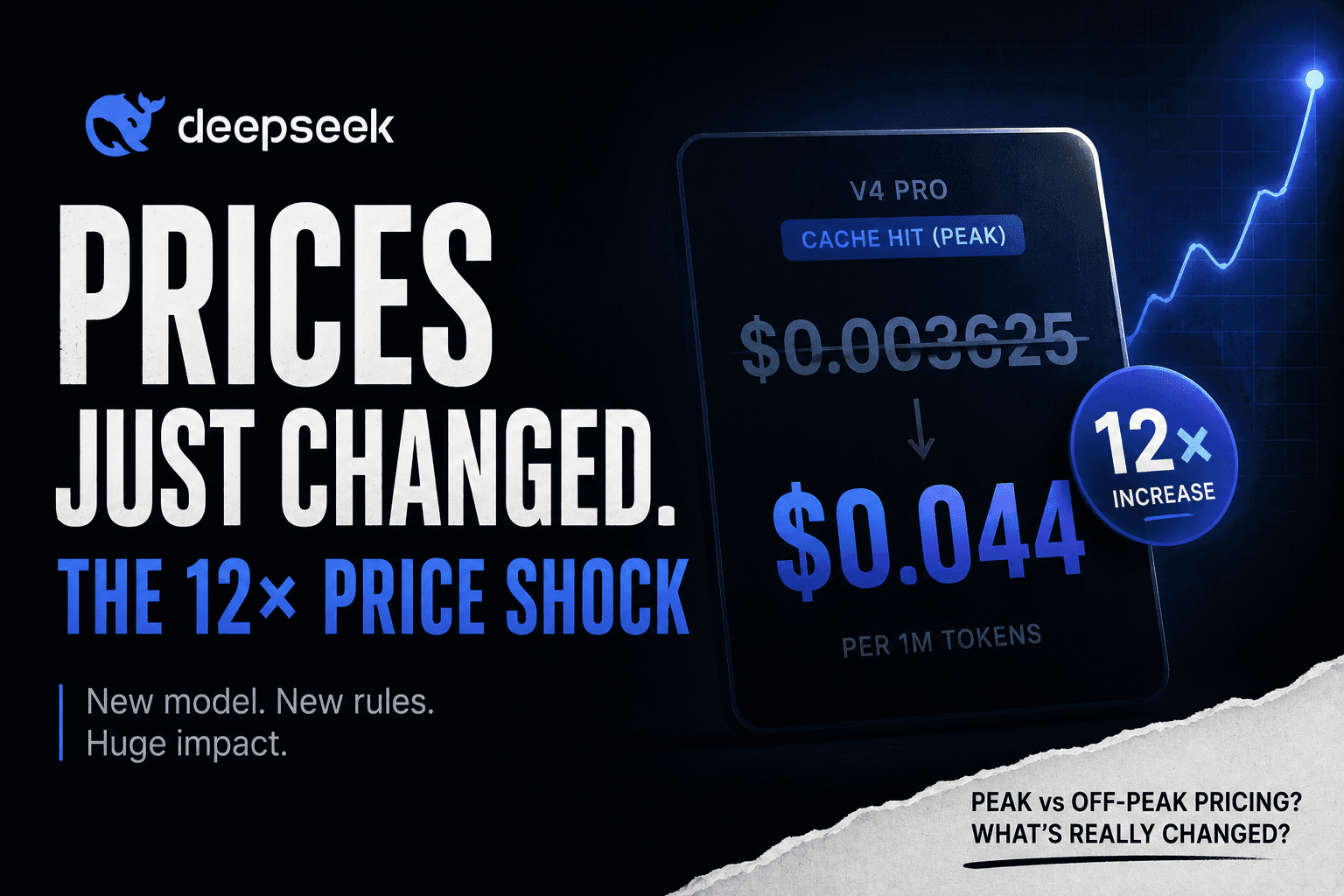
DeepSeek Price Increase 2026: The 12x Nobody Explains
DeepSeek raised API prices on August 16, 2026. The 12x headline is real but misleading. Here is the actual math on what your coding agent costs now, and how to dodge peak hours.
14 min read
Your coding agent got more expensive on Sunday and nobody sent you an email about it.
On August 16, 2026 at 16:00 UTC, DeepSeek killed its flat API pricing and replaced it with peak and off-peak rates. The headlines all screamed the same number: prices up to 1,100% higher. Twelve times the cost. The end of cheap AI.
That number is real. It is also describing a workload almost nobody actually runs.
Here is the honest version. The DeepSeek price increase raises a normal agentic coding session by roughly 4x during peak hours and roughly 2x during off-peak hours. The 12x figure applies only to cache-hit input tokens on V4-Pro, and cache-hit input is the cheapest line item on your bill. Your real cost depends far more on output tokens, and those went up about 4.5x at peak.
Still expensive. Just not apocalyptic. And once you see when the peak windows actually fall, you will realise most of you can dodge them completely.
TL;DR
- New pricing went live August 16, 2026, 16:00 UTC. Two tiers now: peak and off-peak.
- Peak hours are 01:00 to 04:00 and 06:00 to 10:00 UTC. That is only 7 hours out of 24. The other 17 hours are off-peak at half price.
- The famous 12x lands on V4-Pro cache-hit input, which went from $0.003625 to $0.044 per million tokens at peak.
- A realistic 40-turn coding session on V4-Pro goes from about $0.16 to about $0.65 at peak, or about $0.32 off-peak.
- The peak windows map exactly onto the Chinese working day, lunch break included. If you code from India, the US, or Europe, your normal hours are mostly off-peak already.
- Your OpenCode Go subscription did not get more expensive. It got smaller. The limits are denominated in dollars of model spend.
What exactly changed on August 16?
DeepSeek moved from one flat rate per model to two rates that depend on the clock. Off-peak sits at half the peak rate. Both sit above the old flat rate.
Here is the full table for V4-Flash, the model that broke everything by being too cheap:
| Token type | Old flat | New off-peak | New peak |
|---|---|---|---|
| Input, cache miss | $0.14 | $0.22 | $0.44 |
| Input, cache hit | $0.0028 | $0.007 | $0.014 |
| Output | $0.28 | $0.66 | $1.32 |
And V4-Pro, the one people actually run agents on:
| Token type | Old flat | New off-peak | New peak |
|---|---|---|---|
| Input, cache miss | $0.435 | $0.66 | $1.32 |
| Input, cache hit | $0.003625 | $0.022 | $0.044 |
| Output | $0.87 | $1.98 | $3.96 |
All figures per million tokens, straight from DeepSeek's own pricing docs.
Look at the V4-Pro cache-hit row. $0.003625 to $0.044 is a 12.1x jump. That single cell is where every "1,100% increase" headline came from.
Where did the 12x actually land?
On the cheapest thing you buy.
Cache-hit input is what you pay when DeepSeek has already seen those exact tokens recently. Your system prompt. Your project instructions. The file contents your agent pasted in three turns ago. Instead of processing them fresh, the model reads them from cache and charges you a fraction.
Even after a 12x increase, cache-hit input on V4-Pro costs $0.044 per million tokens. Output costs $3.96 per million. Output is still 90 times more expensive than cached input. Multiplying the tiny number by 12 does not make it the big number.
So when does 12x actually show up on your invoice? Only if your workload is close to 100% cache hits with almost no generation. Something like an agent re-reading a giant unchanged context and replying in two sentences, over and over.
I ran that edge case. Two hundred thousand input tokens at 99.9% cache hit, 100 output tokens per call. Old cost: $0.000898 per call. New peak cost: $0.009451 per call. That is 10.5x. You have to build a deliberately strange workload to get near the headline.
Everyone reported the biggest multiplier. Almost nobody reported that the biggest multiplier sits on the smallest number.
That is not DeepSeek being sneaky. That is journalism grabbing the scariest cell in a table.
So what does a real coding session cost now?
Let us do the math the articles skipped.
A typical agentic coding turn resends the whole conversation plus your file context every single time. Say you are on V4-Pro with a 60,000 token context, about 90% of it cached, generating 1,500 output tokens per turn. Forty turns in a session, which is a solid afternoon of work.
Per turn under the old flat pricing:
- 54,000 cached input tokens at $0.003625/M = $0.000196
- 6,000 fresh input tokens at $0.435/M = $0.002610
- 1,500 output tokens at $0.87/M = $0.001305
- Total: $0.004111 per turn
Per turn at the new peak rate:
- 54,000 cached input at $0.044/M = $0.002376
- 6,000 fresh input at $1.32/M = $0.007920
- 1,500 output at $3.96/M = $0.005940
- Total: $0.016236 per turn
Multiply by 40 turns:
| Scenario | Cost per session | vs old |
|---|---|---|
| Old flat pricing | $0.164 | baseline |
| New off-peak | $0.325 | 1.98x |
| New peak | $0.649 | 3.95x |
So a full coding session went from sixteen cents to sixty five cents at worst. Roughly 4x, not 12x.
Now scale it. If you were burning $200 a month on DeepSeek agent traffic, you are looking at about $790 at peak or about $395 off-peak. That is the number that actually hurts, and it is the number nobody put in a headline.
[Image: Side by side bar chart comparing cost per 40-turn coding session under old flat pricing, new off-peak, and new peak rates]
Why are peak hours at such strange times?
This is the part that made me sit up.
Peak is 01:00 to 04:00 and 06:00 to 10:00 UTC. That looks random. Two blocks, a one hour gap in the middle, seven hours total. Why would anyone design that?
Convert it to China Standard Time, which is UTC+8:
- 01:00 to 04:00 UTC becomes 09:00 to 12:00 CST
- 06:00 to 10:00 UTC becomes 14:00 to 18:00 CST
That is the Chinese working day. Nine to twelve, break for lunch, two to six. The one hour gap in the UTC schedule is the lunch break of DeepSeek's domestic users.
DeepSeek did not design a global pricing model. It designed a load-shedding schedule for Hangzhou office hours, and the rest of us are reading it in the wrong timezone. Once you see it, the whole thing stops looking arbitrary and starts looking obvious.
What does this mean if you code from India?
Better news than you expect.
IST is UTC+5:30. Convert the peak windows:
- 01:00 to 04:00 UTC = 06:30 to 09:30 IST
- 06:00 to 10:00 UTC = 11:30 to 15:30 IST
So peak for an Indian developer is early morning and the middle of the workday. Everything from 15:30 IST until 06:30 the next morning is off-peak. That is 15 straight hours at half price, and it includes the entire evening and night.
If you are a student, a side-project builder, or anyone who does their real work after 4pm, you were already paying off-peak rates and did not know it. Your bill roughly doubled instead of roughly quadrupling.
The people getting hit are teams running agents against production during Indian business hours, specifically that 11:30am to 3:30pm block. If that is you, shifting batch jobs by a few hours is the cheapest optimisation available. You can build the schedule expression for it with the cron generator and just remember to reason in UTC, not IST.
For US developers it is even softer. Peak in Eastern Time is 9pm to midnight and 2am to 6am. Your entire workday is off-peak.
Why did your OpenCode subscription get worse without changing price?
Here is the ripple most people missed.
OpenCode Go is $5 for the first month and $10 after that, with access to 19 models including both DeepSeek V4 variants. But its usage limits are not counted in requests or tokens. They are counted in dollars of model spend: $12 per 5 hours, $30 per week, $60 per month.
You see the problem. When the underlying model price goes up 4x, a dollar-denominated cap buys you 4x fewer turns. OpenCode confirmed publicly that Go's limits were updated to reflect the new DeepSeek pricing, and mentioned they are working on something called "operation cheepseek" to host DeepSeek closer to the old rates.
So your subscription cost did not move. Your allowance shrank. That is a price increase that never appears on your invoice, and it is going to confuse a lot of people who assume a fixed monthly fee means a fixed monthly amount of work.
Any harness that resells token access on a spend cap has the same exposure. This was never really about DeepSeek's pricing page. It was about how much of the tooling layer quietly depends on one company staying cheap.
Why did DeepSeek do this at all?
Not greed. Physics.
On August 1, 2026, OpenCode reported that DeepSeek V4 Flash processed 8 trillion tokens in a single day across its platform, 5 trillion on free usage and 3 trillion on paid traffic. In the same week, OpenRouter's rankings had V4 Flash at 7.22 trillion tokens and the number one spot overall.
You cannot serve that on a fixed GPU fleet at $0.28 per million output tokens. DeepSeek's own framing was about needing to "allocate resources more reasonably" and getting users to "schedule their tasks based on actual usage." Translated: please stop hammering us between nine and six, we are out of chips.
Sanchit Vir Gogia of Greyhound Research put the competitive effect plainly in InfoWorld's coverage: "On paper, at peak, against the right comparator, DeepSeek's price advantage does disappear, and in places inverts."
He is right, and it is worth checking that claim yourself. GLM 5.2 through OpenRouter lists around $0.50 input and $3.15 output per million. DeepSeek V4-Pro at peak is $1.32 input and $3.96 output. At peak, GLM 5.2 is cheaper than DeepSeek on both axes. Off-peak, DeepSeek wins again comfortably.
That inversion is brand new. It did not exist a week ago.
How do you actually pay less?
Four moves, in order of how much they save you.
1. Route by the clock. This is the single biggest lever, and it is about fifteen lines of code. Peak is seven hours out of twenty four, so a scheduler that just knows what time it is captures most of the savings.
// Peak windows: 01:00-04:00 and 06:00-10:00 UTC
const PEAK_HOURS_UTC = new Set([1, 2, 3, 6, 7, 8, 9]);

function isPeakNow(date = new Date()) {
  return PEAK_HOURS_UTC.has(date.getUTCHours());
}

// Interactive requests still go through at peak.
// Batch work waits for the cheap window.
export function pickModel({ interactive }) {
  if (interactive) return "deepseek-v4-pro";
  return isPeakNow() ? "deepseek-v4-flash" : "deepseek-v4-pro";
}
2. Defend your cache hits. Cache-hit input is still 30x cheaper than fresh input on V4-Pro even after the increase. Keep your system prompt byte-identical across calls. Put stable content at the front of the context and volatile content at the end. One stray timestamp at the top of your prompt invalidates the whole cache and quietly moves every token to the expensive column.
3. Cut output, not input. Output is the line item that dominates now. Ask for structured, terse responses. If you are getting back a wall of explanation before every code block, you are paying $3.96 per million tokens for prose you skim past. A rough word count check on your typical prompt and response tells you which side of the bill you should be attacking.
4. Stop single-sourcing. The lesson of this week is not "DeepSeek got expensive." It is that a lot of us built on one provider's promotional pricing and called it an architecture. Whatever harness you use, get comfortable switching the model behind it.
Is DeepSeek still worth it in 2026?
Yes, and I want to be honest about how confident I am here.
I have not run DeepSeek V4-Pro as the backing model for a production agent at scale. I run artofcode on Convex and Next.js, and the 22 tools live on the site do not lean on an LLM in the hot path, so I am not going to invent a benchmark for you.
What I can say from the numbers is this. V4-Flash off-peak at $0.66 per million output tokens remains absurdly cheap for anything that is not frontier-hard. V4-Pro off-peak at $1.98 still undercuts most serious open-weight competition. The window where DeepSeek was 20 to 60 times cheaper than frontier models is closed. The window where it is meaningfully cheaper is wide open.
The thing that actually changed is that you now have to think about when your code runs, not just what it runs on. For a generation of developers who grew up on flat per-token pricing, that is a genuinely new muscle.
Takeaways
- The 12x headline is one cell in a table. Model your own workload before you panic or migrate.
- Real agentic sessions cost about 2x more off-peak and about 4x more at peak.
- Peak hours are Chinese office hours. Check what they are in your timezone before you change anything.
- Indian evening coders and US daytime coders are mostly already off-peak.
- Dollar-capped subscriptions like OpenCode Go silently shrank. Watch your limits, not the sticker price.
- Cache discipline matters more than it did last week, and output length matters most of all.
Frequently Asked Questions
How much did DeepSeek prices actually increase in August 2026?
Between roughly 50% and 1,100%, depending on the model, token type and time of day. Output tokens rose about 4.5x at peak and about 2.3x off-peak on both V4-Flash and V4-Pro. The 1,100% figure applies only to cache-hit input tokens on V4-Pro, which went from $0.003625 to $0.044 per million. New rates took effect August 16, 2026 at 16:00 UTC.
When are DeepSeek's peak hours?
Peak windows are 01:00 to 04:00 UTC and 06:00 to 10:00 UTC, seven hours in total. Every other hour of the day is off-peak and billed at exactly half the peak rate. In IST that is 06:30 to 09:30 and 11:30 to 15:30. In China Standard Time it is 09:00 to 12:00 and 14:00 to 18:00, which is DeepSeek's domestic working day.
Why did DeepSeek raise its API prices?
Demand outgrew its compute. DeepSeek V4 Flash processed 8 trillion tokens in a single day on OpenCode on August 1, 2026, and topped OpenRouter's weekly rankings with 7.22 trillion tokens. DeepSeek framed the change as allocating resources more reasonably and encouraging users to schedule tasks around actual capacity, which is a standard way to shed load when GPUs, not margins, are the bottleneck.
Is DeepSeek still cheaper than the alternatives?
Off-peak, yes, and by a clear margin. At peak the advantage narrows and in some comparisons flips. GLM 5.2 via OpenRouter lists around $0.50 input and $3.15 output per million tokens, which undercuts DeepSeek V4-Pro's peak rate of $1.32 and $3.96 on both axes. Off-peak V4-Pro at $0.66 and $1.98 is cheaper again.
Did OpenCode Go get more expensive?
The subscription price did not change. It is still $5 for the first month and $10 per month afterwards. But Go's usage limits are denominated in dollars of model spend, currently $12 per 5 hours, $30 per week and $60 per month, so a 4x increase in DeepSeek's rates means those caps buy roughly 4x fewer DeepSeek turns. OpenCode has said it is working on hosting DeepSeek closer to the old pricing.
Want to shift your heavy jobs into the cheap window? Build the schedule in about thirty seconds with the cron generator, or browse the rest of the free developer tools on Art of Code.
Written by Adithya Guttha, Founder of Art of Code.