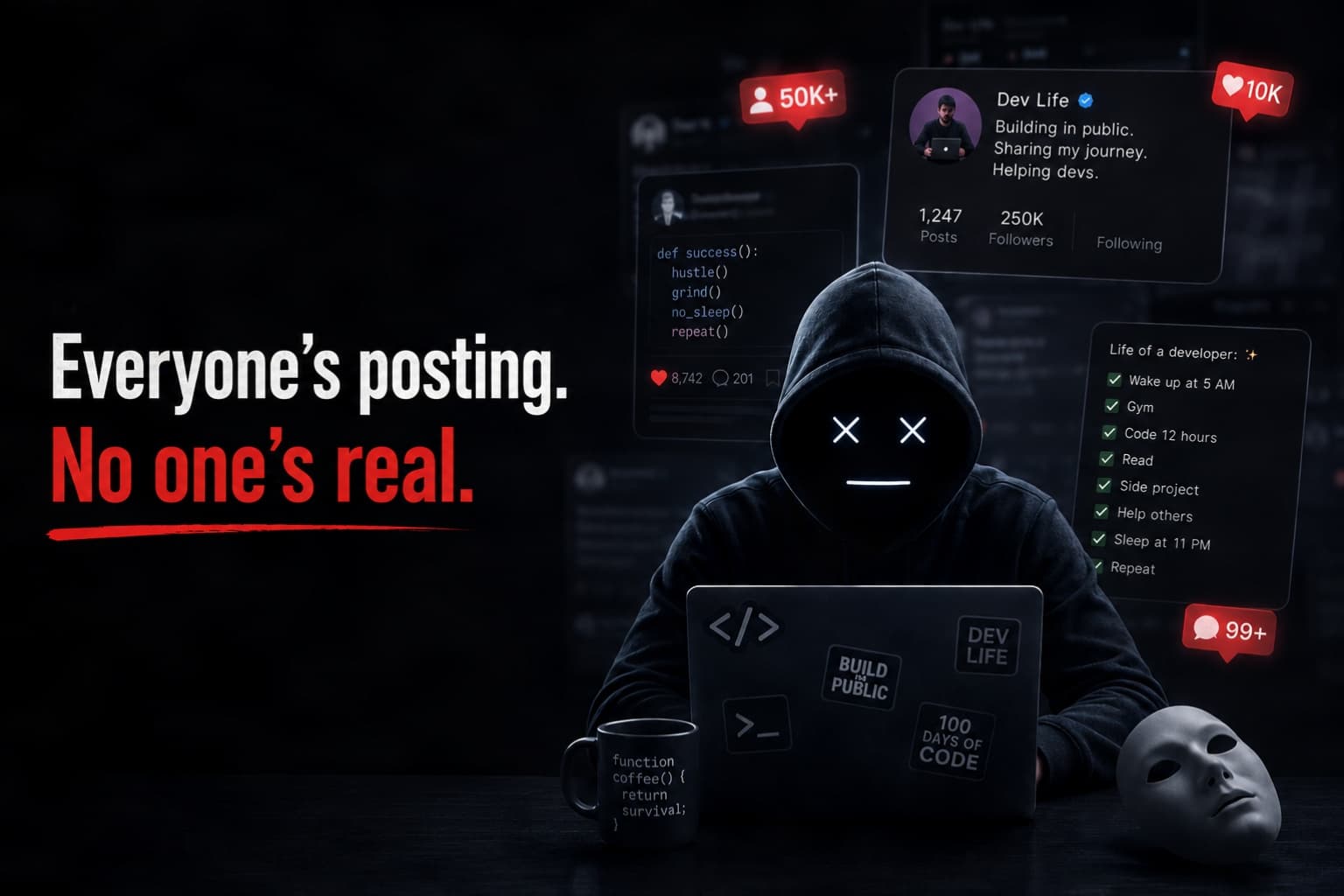
Why Developer Social Media Feels Fake in 2026 (The Data)
Your feed is not built to inform you, it is built to hold you. The 2026 data on AI slop, the hype business model, and how to get your focus back.
Open X right now and scroll for sixty seconds. Count how many posts told you that you are already behind, that some tool will 10x you, or that a thing you have used for five years is suddenly dead. That feed is not an accident. It is a slot machine built by people who get paid when you panic.
So let me say it plainly. Developer social media feels fake in 2026 because most of it is not built to inform you, it is built to hold you. The advice is downstream of the payout. Once you see the money flow, the whole timeline reads differently, and you stop taking career decisions from people whose actual job is being looked at.
I am not writing this as an outsider throwing rocks. I run a content engine for my own product. I know the levers. That is exactly why you should trust this post a little less and verify it yourself, which, funny enough, is the entire point.
Key takeaways
- "Fake" does not only mean bots. It means performative. Real people manufacturing certainty they do not have, because certainty gets clicks.
- 2026 data: Gartner estimates 60%+ of new web content is AI-generated, bots are 51% of web traffic, and humans are now the minority online.
- Developers are easy to manipulate because the hype carries a career threat ("adapt or get left behind") that older tech fads never had.
- The economics are brutal: X paid creators $415M in 2025, but the median monetized account earned under $400 while the top 1% took $52K+.
- The fix is not quitting. It is batching your hype intake, demanding demonstrated experience, and spending the reclaimed hours building.
What does "fake" actually mean here?
It does not mean every account is a bot, though plenty are. The dangerous kind of fake is the performance.
A few years ago, if you asked a senior engineer whether you should use some tool, the honest answer was almost always the annoying one: "it depends." It depends on your scale, your team, your timeline. That answer is correct and it is also terrible for engagement. Nuance does not trend.
So the incentive quietly rewired who talks. Now the loudest voice in your feed is rarely the person with fifteen years of scar tissue. It is the person who learned one tool last month and posted "X is dead, here is what to use instead" with total confidence. Confidence is the product. The blue check is a receipt, not a credential.
Picture taking travel advice from someone who only ever photographs hotel lobbies. The photos look incredible. They have never walked the actual streets. That is most of the career advice in your timeline.
How much of the internet is even real anymore?
This is the part that should genuinely unsettle you, because it is measured, not vibes.
Gartner estimates that more than 60% of all new text and image content on the open web is now AI-generated. Ahrefs analyzed 900,000 pages published in April 2025 and found 74.2% contained AI-generated content. Bot traffic crossed 51% of all web traffic in 2026, up from 42% three years earlier, which means actual humans are now the minority online. The linguist Adam Aleksic put it well in a 2025 interview: the dead internet theory "used to be a lunatic fringe conspiracy theory, but it's looking a lot more real."
You feel this every time you search for a real answer and wade through six near-identical articles with the same headings and the same stock cover image before finding one a human clearly wrote. That sludge has a name now. People call it AI slop, and it is not made for you. It is made for the algorithm and the ad slot.
When the feed is mostly machines performing for other machines, "what is everyone saying" stops being useful information. It is just weather.
Why are developers, of all people, this easy to manipulate?
This one stings, because we are supposed to be the logical ones. We debug race conditions for fun. And we still fall for "this framework is over" every quarter.
Here is why. Old tech fads, the JavaScript framework wars, the NoSQL gold rush, were annoying but low stakes. You could ignore them and keep shipping. The 2026 hype is different. It comes wrapped in a threat to your livelihood. Every other post implies that if you do not adopt this thing today, you personally become unemployable. That fear short-circuits the part of your brain that asks "wait, is this actually true for my situation."
I do not blame anyone for flinching. It is hard to think clearly when a thousand strangers are calmly telling you your career is ending. But notice the move. The same people warning you that you will be left behind are usually selling the ladder.
The hype machine has a business model, and you are the inventory
Strip the romance off and look at the cash.
After the platform changes, X tuned its payouts to reward engagement from verified users, and controversy is the cheapest engagement there is. A measured, useful thread gets ignored. A confident "nobody should ever use Y again" thread prints. So that is what gets made, on purpose, at scale.
And the money is not even there for most people. X paid out roughly $415M to creators in 2025. Sounds huge, until you see the split: the top 1% of monetized accounts earned $52,000 or more, while the median monetized account made under $400 for the entire year. The "make money with AI" guy teaching you to make money with AI is, statistically, not making money with AI. He is making money telling you to.
That is the tell. Nobody hands you their actual million-dollar insight in a free thread. If it is free and loud, you are not the customer. You are the reach.
What is this quietly costing you?
Not just money. Attention, which for a builder is the only real currency.
Product Hunt lists more than 30 new AI tools every single day. Filter hard for developer-relevant ones and you still get 5 to 10 launches a day worth a glance. Glancing is not free. Reading the landing page, watching the demo, deciding if it matters, that is 2 to 5 hours a day if you actually try to keep up. And most of these tools ship in permanent beta: the docs are half wrong, the API changes every two weeks, and the killer feature is deprecated in three months for a "new direction."
So you spend your sharpest hours evaluating things that will not exist by Diwali, and your real project sits untouched. The cost is not the subscription. It is the feature you did not build because you were busy being current.
When I was building Art of Code I made a rule that felt insane at the time: check X once a week, not once an hour. I shipped 17 developer tools in that stretch. Correlation is not causation, and I am not pretending I invented focus. But I have never once needed a hot take to ship a feature. Not once.
So what actually works?
You do not need to delete your accounts and move to a cabin. You need a filter. Here is the one I actually use.
Batch the hype. Do not stream it. Pick one window. Once a week, or once a month if you are deep in a build. On that day, go through everything at once. New models, new tools, the discourse. Try the two that look genuinely relevant. The rest was noise that expired before you got to it. You will not miss anything that mattered. If a tool is still being talked about a month later by people who actually shipped with it, then it earned your attention.
Make people earn your trust with receipts. Default to skeptical. Before you take advice, ask one question: has this person actually built and run the thing they are loud about, or do they just talk about it. Demonstrated experience over verified confidence, every time.
Spend the reclaimed time building, not consuming. This is the whole game. The developers who win the next few years are not the ones with the best awareness of every tool. They are the ones with the best judgment about which few things deserve depth. You build that judgment by shipping real projects, not by reading about them. If you want a structured push, our free workshop is built to get you making instead of doomscrolling, and the practice arena is there to drill the fundamentals that no hype cycle can take from you.
The relief is real, by the way. When you stop trying to drink the whole firehose, the anxiety that you assumed was just "being a developer in 2026" mostly drains away. It was never the job. It was the feed.
Actionable takeaways
- Treat your timeline like weather, not data. Interesting, mostly noise, do not plan your career around it.
- One hype window per week. Everything else waits. The important stuff survives the wait.
- Before trusting advice, check if the person has shipped the thing or just posts about it.
- Every hour you would have spent evaluating a tool that dies in three months, put one into your own project instead.
- Assume free and loud content is selling you something. Usually hope, sometimes a course.
Frequently Asked Questions
Is developer social media actually fake or just annoying?
Both, but the harmful part is the performance, not bots. Real people manufacture confidence and certainty they have not earned because nuanced, accurate takes get punished by engagement-based algorithms. The result is a feed where the loudest voice is usually the least experienced one, which makes it actively misleading for career decisions, not just irritating.
How much of the internet is AI-generated in 2026?
By current estimates, the majority of new content is. Gartner puts AI-generated text and images at over 60% of new web content, an Ahrefs analysis found 74.2% of sampled 2025 pages contained AI content, and bot traffic is now around 51% of all web traffic. Practically, that means a lot of what you read online was never written for a human to learn from.
Why do developers fall for tech hype so easily?
Because 2026 hype is attached to a career threat. Older fads were low stakes, but current messaging implies you will become unemployable if you do not adopt the newest tool immediately. That fear bypasses normal skepticism. The people amplifying the fear are frequently the ones selling the solution to it.
Do tech influencers actually make money giving advice?
A tiny fraction do. X paid creators about $415M in 2025, but the median monetized account earned under $400 for the year while the top 1% earned $52,000 or more. Most "make money with AI" creators earn from the content about making money, not the method itself. Free, loud advice is almost always promoting something.
Try this today
Set one hype window for the week and close every other tab. Then open a real project, even a tiny one, and ship a single change. If you want a guided way back into building instead of scrolling, start with the free workshop and keep your fundamentals sharp in the practice arena.
Written by Adithya Guttha, Founder of Art of Code.