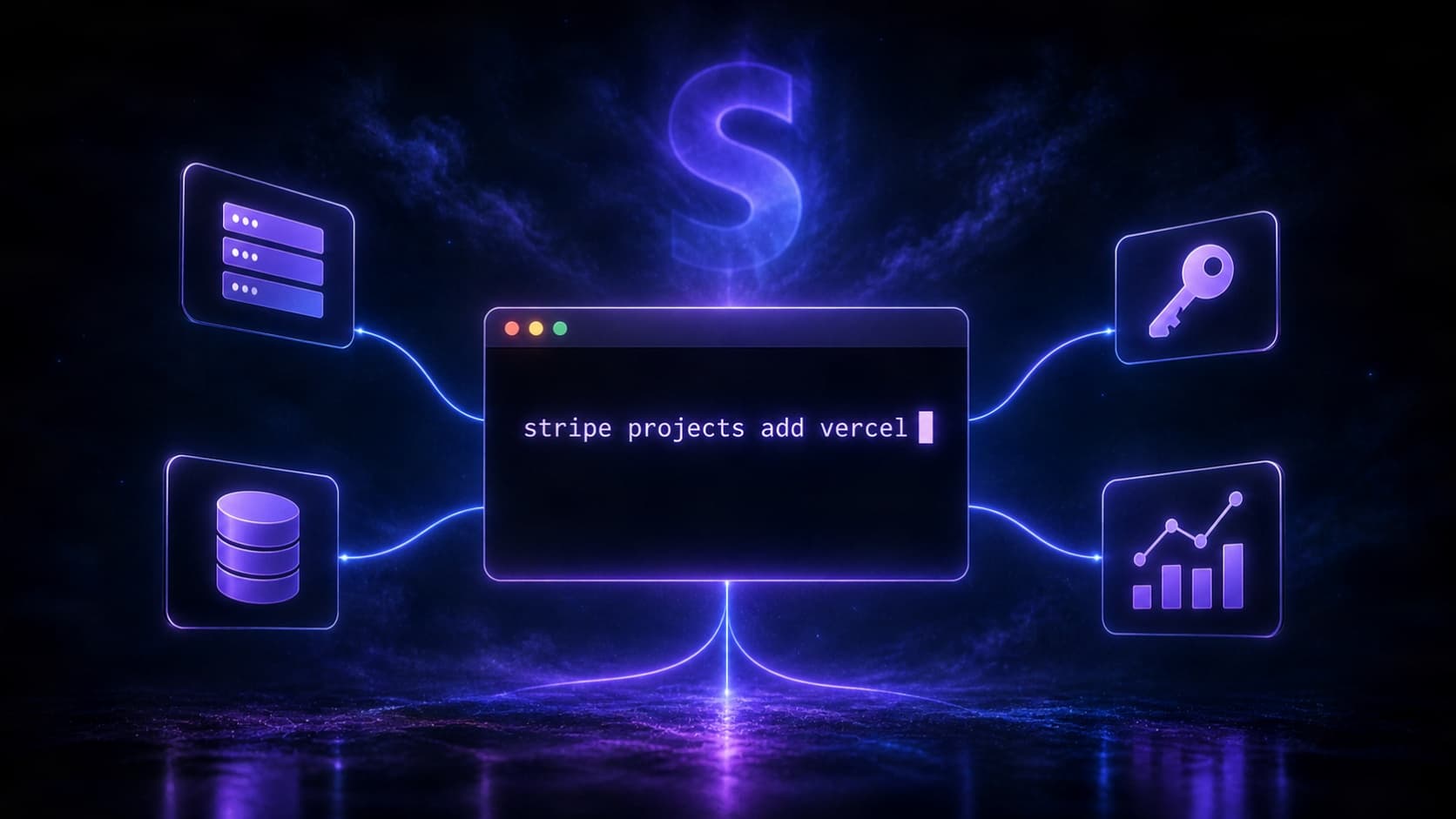
What Is Stripe Projects? The CLI Letting AI Agents Build Real Infrastructure
Stripe just shipped a CLI that lets your AI agent provision Vercel, Neon, Clerk, ElevenLabs and 27 other cloud services with one command. Here's why only Stripe could ship this.
Stripe just shipped something most developers haven't fully processed yet.
It's not a new payment API. It's not a checkout widget. It's a CLI tool called Stripe Projects that lets you, or your AI agent, provision real infrastructure across 31 different cloud providers from a single command line.
Neon database. Vercel hosting. Supabase auth. Clerk users. PostHog analytics. ElevenLabs voice. All of it, spun up, credentialed, and billed through one terminal.
The quiet detail: Stripe is the only company on earth that could have shipped this. And once you understand why, the move stops looking like a side project and starts looking like one of the most strategic plays of 2026.
Let me walk you through it.
What Stripe Projects actually does
Stripe Projects is a plugin for the existing Stripe CLI. You install it with one command:
stripe plugin install projects
From there, you run stripe projects init my-app and you get a folder with a few files: an agents.md, a claude.md, a .cursorrules, a projects/ directory, and an encrypted vault for credentials.
Then you ask the catalog what's available:
stripe projects catalog
And it returns a list. 54 services across 31 providers in 18 categories, last I checked. Hosting (Vercel, Cloudflare, Render, Netlify, Railway, Fly.io). Databases (Neon, PlanetScale, Supabase). Auth (Clerk). Analytics (PostHog, Amplitude, Mixpanel). AI (ElevenLabs, others). Object storage. Observability. The full modern stack.
Want a Postgres database? Run stripe projects add neon. The CLI provisions a real Neon account, creates a database, drops the connection string into your .env, and you're querying in under a second. Stripe's own demo at Sessions 2026 showed Neon spinning up in under 350 milliseconds with zero human interaction.
No signup forms. No CAPTCHAs. No clicking the "verify email" link. Your agent just runs the command and the resource exists.
The catch that explains everything
Now here's the part that makes most people stop and go "wait, how is that legal."
Provisioning a real account on Vercel or Supabase normally involves a hard wall of friction. Email verification. Phone verification. CAPTCHA. Sometimes credit card pre-auth. These aren't bugs. They're the line of defense between a SaaS product and a million scripted bot signups draining the free tier.
So how does Stripe just bypass all of that? Why are these providers handing over real accounts to a CLI command?
Because Stripe is doing something none of the other big platforms can do. Stripe is selling KYC as a feature.
When you sign up for a Stripe account as a merchant, Stripe verifies your identity. Real name. Real bank account. Real address. Sometimes real ID. They have to. Payment regulators force them to.
Now Stripe is taking that verified identity and offering it to providers as a trust signal. When stripe projects add vercel runs, Stripe is essentially saying to Vercel: "This is a real verified human or business. We've checked. Skip the friction. Create the account."
Vercel says yes because the alternative is missing out on a fast-growing channel where AI agents are the ones picking infrastructure. Vercel skips the friction, gets a real customer, and gets paid through Stripe's existing rails.
This is the move that's almost impossible to copy. Google can't ship this. Cloudflare can't ship this. AWS can't ship this. None of them have the legal-grade KYC pipeline that a payments company has been forced to build.
Why this is built for AI agents, not humans
Look at the files Stripe Projects drops into your repo when you run init:
agents.md— instructions for AI agents on how to use the CLIclaude.md— same, redirected to agents.md.cursorrules— Cursor-specific guidanceprojects/state— machine readable statevault— encrypted credentials
The documentation literally says: "Never look at any files in projects directory. The CLI manages everything for you."
It's saying that to your AI. Not to you. The whole tool is designed for an agent to read the catalog, pick a service, run the command, get the credentials, and start coding, all without a human ever opening a browser tab.
This is the part that flew under most people's radar at Stripe Sessions 2026. Stripe wasn't shipping a tool that helps you. They were shipping infrastructure for the agentic commerce era they've been telegraphing for over a year now.
They announced agent guardrails alongside Projects. You can assign an AI identity, scope what services it can provision, set a spending cap, and configure approval flows for sensitive actions. It's the kind of plumbing you'd build if you genuinely believed agents are about to be the ones provisioning most new infrastructure on the internet.
Which, going by what I'm seeing in 2026, is exactly what's happening.
The features that surprised me
I played with this for a couple of hours and a few things stood out.
Credential rotation is one command. Run stripe projects rotate <service> and the API key gets revoked, replaced, and updated in your env file. No dashboard hunting. No deploy scramble. If you've ever had a key leak in a public repo, you understand how rare this is.
The vault encrypts everything locally. Your API keys aren't sitting in plain .env text. They're in an encrypted file the CLI decrypts only when needed. If your laptop gets compromised, attackers don't walk away with a clean credential dump.
Magic link SSO into provider dashboards. Run stripe projects dashboard <service> and your browser opens directly into your account on that provider's site, already logged in. No password manager dance. The CLI brokers an SSO handoff in the background.
One Stripe account, one billing pipe. Every paid service in the catalog bills through your existing Stripe payment method. You don't end up with twelve invoices from twelve providers. One unified bill, one statement, one reconciliation.
That last point is the second strategic wedge. Stripe takes its standard cut on every paid service that flows through Projects. Vercel hosting? Stripe takes a slice. PlanetScale database? Stripe takes a slice. ElevenLabs voice usage? Stripe takes a slice.
They've quietly turned themselves into the toll booth between AI agents and the rest of the cloud.
What this changes for indie builders
If you build solo or in a small team, this is genuinely useful right now, not in some hypothetical future.
Think about how you start a typical web project today. Pick a host. Pick a database. Pick an auth provider. Pick analytics. Spin up four browser tabs. Sign up four times. Copy four sets of API keys into one .env file. Hope you didn't fat-finger one.
With Stripe Projects, that whole sequence collapses into:
stripe projects init my-app
stripe projects add vercel
stripe projects add neon
stripe projects add clerk
stripe projects add posthog
Five commands. Done. Every credential lands in your env file, encrypted in your vault, billed through one Stripe account. You go from nothing to a deployable production stack in around two minutes.
For people just starting to ship side projects, this lowers the cost of the first commit dramatically. You don't have to know what auth provider to pick. You ask the catalog. You don't have to set up four credit cards. You set up one.
For seasoned devs, the value is different. It's the end of the MCP server zoo. A lot of us have been juggling 10 to 20 MCP servers (one per provider) inside Claude Desktop or Cursor just to give our agents access to infrastructure. Stripe Projects collapses that into a single CLI surface that any agent can already use.
What I'd watch out for
Before you go all in, a few honest concerns.
Stripe lock-in. This whole flow assumes you have a Stripe account in good standing. If Stripe ever decides they don't like your business (it happens), you don't just lose payments. You lose your provisioning layer for half your stack.
Provider opacity. When stripe projects add elevenlabs creates an account for you, you're trusting two companies (Stripe and the provider) to handle your data correctly. Read the consent prompt. It tells you exactly what gets shared.
Catalog gaps. 31 providers is a lot, but it's not everyone. If your stack relies on a smaller niche tool, you're back to the manual flow for that one. The catalog will grow, but it won't cover everything for a while.
Agent runaway risk. The whole point is letting agents provision things. Without spending caps and approval flows configured, an agent loop could absolutely rack up a five-figure bill before you notice. Use the guardrails. Don't trust the defaults.
The bigger picture
What Stripe shipped here isn't really a CLI. It's a bet.
They're betting that within a few years, most new cloud infrastructure on the internet will be provisioned by AI agents, not humans clicking through dashboards. They're betting that those agents will need a trusted identity layer to bypass anti-abuse friction. And they're betting that the company sitting at that identity layer gets to take a cut of the entire downstream economy.
If they're right, Stripe Projects becomes the default way developers and agents touch the cloud. If they're wrong, it's a clever CLI tool that didn't go far.
My money is on right. The KYC wedge is too clean. The cross-provider billing aggregation is too useful. And the timing, with personal AI agents like OpenClaw exploding into the mainstream, is exactly when this kind of infrastructure starts to matter.
If you build software for a living in 2026, install the CLI this week. Spin up a tiny side project with it. You don't have to commit to anything. But you do want the muscle memory of "agent commands a real cloud service" before this becomes the default way most apps get built.
It won't be the only path. But it's going to be one of the big ones.
Written by Curious Adithya for Art of Code.