Supervised Machine Learning: Learning from Experience
Supervised Machine Learning is one of the most important ideas in modern artificial intelligence. Most real-world AI systems, from spam filters to recommendatio...
Supervised Machine Learning is one of the most important ideas in modern artificial intelligence. Most real-world AI systems, from spam filters to recommendation engines, are built on this simple but powerful concept: learning from labeled examples.
At its heart, supervised learning is about teaching a system using past experience so that it can make better decisions in the future.
The Idea Behind Supervised Learning
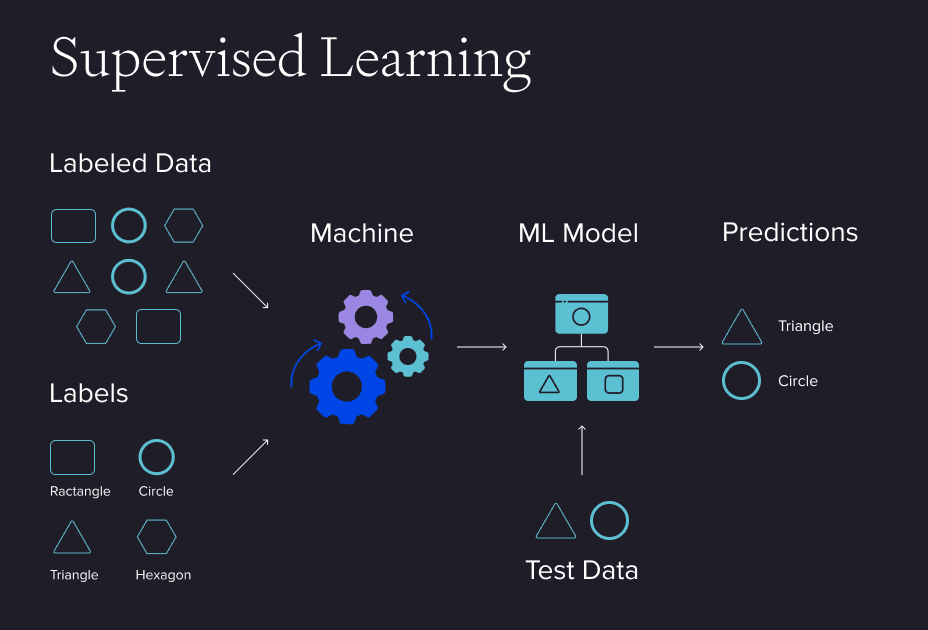
In supervised learning, the model learns from data where the correct answers are already known. Each input comes with a corresponding output, and the model’s job is to understand the relationship between them.
It’s similar to how a student learns with a teacher. The teacher provides questions along with correct answers, and over time, the student learns the patterns needed to solve new problems.
The goal is not just to remember answers, but to learn how to arrive at them.
Learning a Pattern Between Input and Output
At a conceptual level, supervised learning is about finding a hidden relationship between inputs and outputs.
For example, if you are trying to predict house prices, the input might include features like size, location, and number of rooms, while the output is the price. The model studies many such examples and tries to learn how these features influence the final price.
Once trained, it should be able to predict the price of a new house it has never seen before.
This ability to move from examples to general rules is what makes machine learning powerful.
The Role of Data
Data is the foundation of supervised learning. Without labeled data, the model has nothing to learn from.
A dataset typically consists of input features and their corresponding labels. The quality, quantity, and diversity of this data have a huge impact on how well the model performs.
If the data is incomplete or biased, the model will also learn those imperfections. This is why data preparation is often more important than the model itself.
How Learning Actually Happens
During training, the model makes a prediction based on input data. It then compares this prediction with the actual correct answer. The difference between the two is called error.
The model adjusts itself to reduce this error. This process is repeated many times, gradually improving the model’s performance.
Over time, the model becomes better at recognizing patterns and making accurate predictions.
In simple terms, it learns by making mistakes and correcting them repeatedly.
Regression and Classification
Supervised learning problems usually fall into two main categories.
In regression problems, the goal is to predict continuous values. Examples include predicting house prices, temperature, or stock values.
In classification problems, the goal is to assign inputs into categories. Examples include detecting whether an email is spam or not, or identifying whether an image contains a cat or a dog.
Although the outputs are different, the learning process remains the same—understanding patterns in data.
Generalization: The Real Objective
The true purpose of supervised learning is not to perform well on the training data, but to perform well on new, unseen data.
This ability is called generalization.
A model that memorizes training data may perform perfectly on it but fail in real-world situations. A good model instead learns patterns that apply broadly, not just specific examples.
Generalization is what makes a model useful outside the lab.
Overfitting and Underfitting
One of the biggest challenges in supervised learning is finding the right balance in learning.
If a model becomes too complex, it may start memorizing training data instead of learning patterns. This is known as overfitting. Such a model performs well on training data but poorly on new data.
On the other hand, if a model is too simple, it may fail to capture important patterns. This is known as underfitting.
The goal is to find a balance where the model is neither too simple nor too complex.
Why Supervised Learning Works
Supervised learning works because real-world data is structured. There are underlying patterns and relationships between inputs and outputs, even if they are not immediately visible.
For example, certain symptoms are often linked to specific diseases. Certain behaviors may indicate fraud. Certain product choices are influenced by user preferences.
Machine learning models are designed to detect and learn these hidden relationships.
Real-World Impact
Supervised learning is everywhere around us. It powers email spam detection, recommendation systems on streaming platforms, fraud detection systems in banking, and even medical diagnosis tools.
Whenever a system predicts something based on past labeled data, supervised learning is likely at work.
Final Thoughts
Supervised machine learning is one of the simplest yet most powerful ideas in artificial intelligence. It is built on the principle of learning from examples and improving through feedback.
In essence, it allows machines to learn from the past and make intelligent predictions about the future.