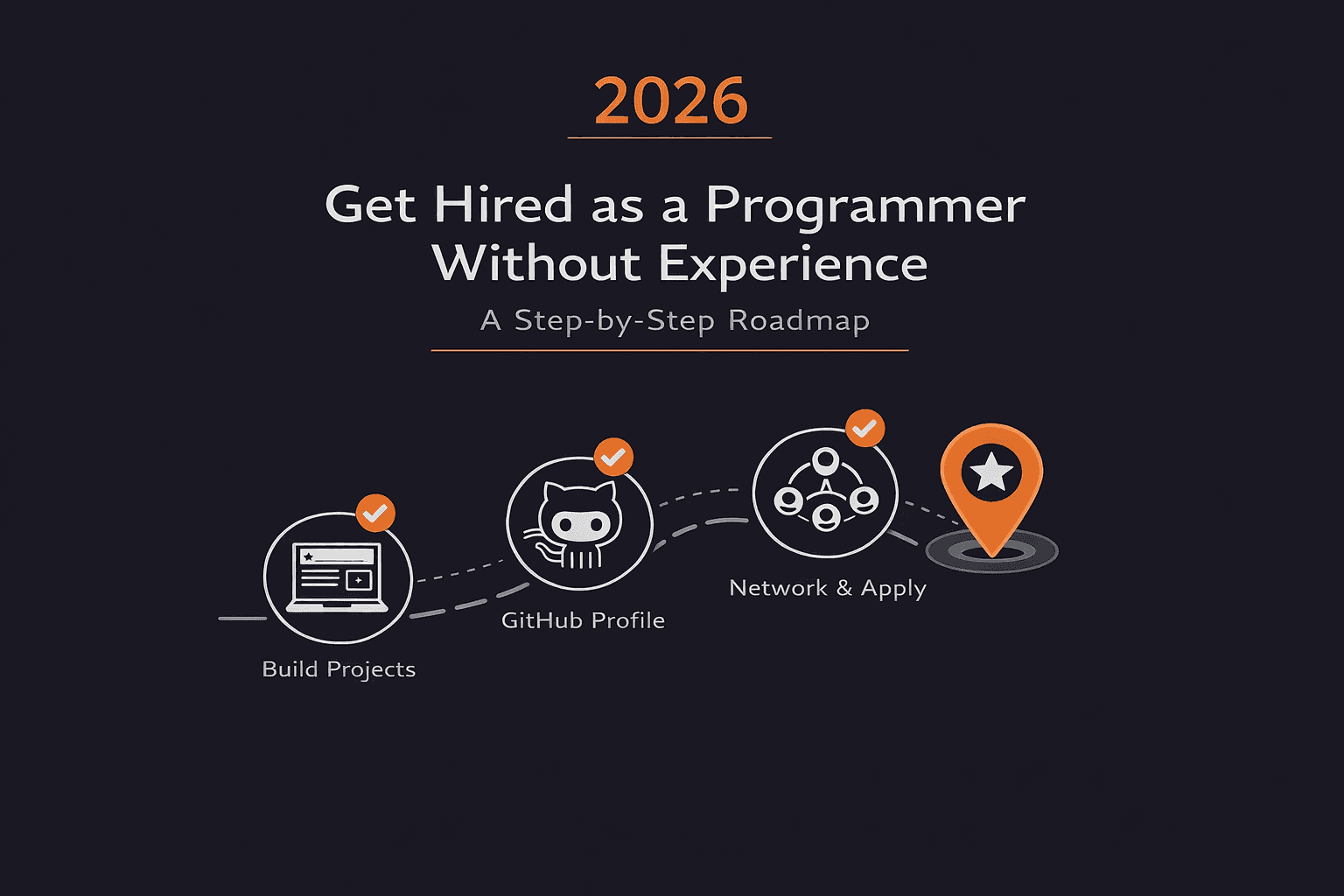
How to Get a Programming Job With No Experience in 2026
You don't need years of experience to land your first programming job. Build 3-5 projects, contribute to open source, network on LinkedIn, apply to 100+ positions. Here's the complete roadmap.
Short answer: You don't need years of experience to land your first programming job. Build a portfolio with 3-5 real projects, contribute to open source, network on LinkedIn, and apply to 100+ positions. Companies care more about what you can build than where you've worked.
It's actually easier to break into tech now than ever before.
Is it really possible to get hired with no experience?
Yes. Here's why.
Tech companies are shifting from "degree required" to "skills required."
They care less about:
- Where you went to school
- How many years you've worked
- Whether you have a CS degree
They care more about:
- Can you actually code?
- Can you solve problems?
- Can you build things?
- Can you work on a team?
Proof this works:
People are landing their first tech jobs every day with:
- No degree
- No bootcamp
- No formal experience
- Just self-taught skills and projects
The biggest lie: "You need experience to get experience."
The truth: You need proof you can code to get hired.
And you can create that proof yourself.
What hiring managers actually look for
I've talked to dozens of hiring managers. Here's what they actually care about when hiring junior developers:
1. Can you code?
They don't care if you learned at MIT or from YouTube.
They want to see: Working code that proves you know what you're doing.
2. Can you learn?
Tech changes constantly. They need people who can teach themselves new tools.
They want to see: Projects using modern technologies. Active GitHub. Recent learning.
3. Can you communicate?
Most bugs happen because of miscommunication, not bad code.
They want to see: Clear README files. Good code comments. Ability to explain your work.
4. Will you fit the team?
Technical skills can be taught. Attitude can't.
They want to see: Collaborative projects. Open source contributions. Professionalism.
Notice what's NOT on this list:
- Years of experience
- Computer Science degree
- Previous job titles
Experience matters. But "professional experience" and "coding experience" are different things.
You can gain coding experience without a job.
The Step-by-Step Roadmap
Here's exactly how to go from zero experience to hired.
Complete Roadmap Table
| Step | What to Do | Time Needed |
|---|---|---|
| 1 | Learn fundamentals (HTML, CSS, JavaScript OR Python) | 2-3 months |
| 2 | Build 3-5 portfolio projects | 2-3 months |
| 3 | Create GitHub profile and push all projects | 1 week |
| 4 | Contribute to 2-3 open source projects | 1-2 months |
| 5 | Build professional LinkedIn profile | 1 week |
| 6 | Do 3-5 freelance projects (even unpaid) | 2-3 months |
| 7 | Network: LinkedIn, Twitter, local meetups | Ongoing |
| 8 | Apply to 100+ jobs, prepare for interviews | 1-3 months |
| Total | From zero to first job | 6-12 months |
This timeline assumes 2-3 hours per day of focused work.
Step 1: Learn the Fundamentals (2-3 months)
Pick one path and stick with it:
Path A: Web Development
- HTML, CSS, JavaScript
- React or Vue (pick one)
- Node.js for backend
Path B: Python Development
- Python fundamentals
- Django or Flask for web
- Data structures and algorithms
Path C: Mobile Development
- React Native (uses JavaScript)
- Swift (iOS) or Kotlin (Android)
Don't learn everything. Master one stack.
Free resources:
- freeCodeCamp (web development)
- The Odin Project (full-stack)
- CS50 (fundamentals)
- YouTube tutorials
Paid resources (worth it):
- Frontend Masters
- Udemy courses on sale
- Codecademy Pro
Goal: Build 3-5 small projects while learning (calculator, todo app, weather app).
Step 2: Build a Portfolio (2-3 months)
Here's the truth: Personal projects ARE experience.
Hiring managers don't care if you built it for a company or for yourself.
They care if you can build things.
What to build:
Project 1: CRUD Application
Build a full-stack app with Create, Read, Update, Delete functionality.
Examples:
- Blog platform
- Recipe manager
- Expense tracker
- Book collection app
Why this matters: 90% of web apps are CRUD apps. Prove you can build one.
Project 2: API Integration
Build something that uses external APIs.
Examples:
- Weather dashboard (OpenWeather API)
- Movie search (TMDB API)
- GitHub profile viewer (GitHub API)
- Crypto price tracker (CoinGecko API)
Why this matters: Shows you can work with real-world data.
Project 3: Deployment
Build and deploy a live application.
Examples:
- Personal portfolio website
- E-commerce store (even fake products)
- Real-time chat app
- Social media clone
Why this matters: Proves you can ship code to production, not just localhost.
Bonus Projects:
- Mobile app (if you learned React Native)
- Chrome extension
- Command-line tool
- Automation script
Each project should:
- Solve a real problem
- Have clean, commented code
- Include a detailed README
- Be deployed and live (use Vercel, Netlify, Heroku)
Step 3: Build Your GitHub Profile (1 week)
Your GitHub is your resume as a developer.
Hiring managers will look at it before talking to you.
What to do:
1. Push all projects to GitHub
Create repos for each project with:
- Clear README (what it does, how to run it, technologies used)
- Clean code with comments
- Screenshots or demo GIFs
- Live demo link
2. Make contributions every week
Even small commits count. Work on projects regularly.
Green squares don't guarantee jobs, but empty GitHub profiles hurt your chances.
3. Pin your best projects
GitHub lets you pin 6 repos. Choose:
- Your 3 best complete projects
- 1-2 work-in-progress projects (shows you're actively coding)
- 1 open source contribution (if you have one)
4. Write a good profile README
Use GitHub's profile README feature to showcase:
- Who you are
- What you're learning
- What you're building
- How to contact you
Step 4: Contribute to Open Source (1-2 months)
This is the cheat code for "no experience."
Open source contributions = professional coding experience.
Why this works:
- You work with real codebases
- You collaborate with experienced developers
- You learn Git workflows (pull requests, code review)
- Hiring managers see you can work on teams
How to start:
Find beginner-friendly projects:
- GitHub topics: "good first issue" or "beginner friendly"
- Websites: firsttimersonly.com, goodfirstissue.dev
- Look for projects you actually use
Start small:
- Fix typos in documentation
- Add missing tests
- Improve README files
- Fix small bugs labeled "good first issue"
Don't aim for huge contributions at first.
One merged pull request is better than zero.
Step 5: Build Your LinkedIn Profile (1 week)
LinkedIn is where recruiters find you.
Even if you're applying directly, recruiters will check your LinkedIn.
How to optimize it:
Headline:
Don't write: "Looking for opportunities"
Write: "Frontend Developer | React, JavaScript, TypeScript | Building web applications"
About section:
Tell your story in 3-4 short paragraphs:
- Who you are now (developer, what you specialize in)
- What you're building (portfolio projects)
- What you're looking for (junior developer roles)
- How to reach you
Experience section:
Even with no job, you have experience:
"Freelance Web Developer" (Self-Employed)
- Built 5+ full-stack web applications
- Technologies: React, Node.js, MongoDB
- Deployed projects to production with 1000+ users
"Open Source Contributor"
- Contributed to X open source projects
- Fixed bugs, added features, improved documentation
Projects section:
Add your portfolio projects here with links.
Skills section:
Add every technology you know. People search LinkedIn by skills.
Skills to add:
- Programming languages (JavaScript, Python, etc.)
- Frameworks (React, Django, etc.)
- Tools (Git, Docker, etc.)
- Soft skills (Problem Solving, Communication)
Get endorsements: Ask friends who know you can code to endorse your skills.
Step 6: Do Freelance Work (2-3 months)
"But I need experience to get freelance work!"
No, you don't.
Start with free/cheap work to build testimonials.
Where to find clients:
1. Friends and family
Ask if anyone needs:
- A website for their small business
- A landing page for a side project
- Help with their existing website
- An app idea they have
Build it for free or cheap ($100-500).
Get a testimonial. Add to portfolio.
2. Local businesses
Walk into local businesses with bad websites.
Offer to rebuild it for $500-1000.
Most will say no. Some will say yes.
One client = real professional experience.
3. Freelance platforms
- Upwork (competitive but possible)
- Fiverr (start with small gigs)
- Freelancer.com
Set your rate low at first ($15-25/hour).
Goal: Get 3-5 projects with 5-star reviews.
Then raise your rates.
4. Reddit, Discord, Twitter
Look for:
- r/forhire
- r/slavelabour (yes, really , there are a lot of people who post small paid tasks)
- Twitter #buildinpublic community
- Discord dev communities
Even 3-5 small freelance projects prove:
- You can work with clients
- You can meet deadlines
- You deliver working code
- People trust you enough to pay you
This is experience. Put it on your resume.
Step 7: Network Like Your Career Depends On It (Ongoing)
Most jobs are filled through referrals, not job boards.
You need people in your corner.
Online networking:
LinkedIn:
- Connect with developers in your city
- Comment on their posts
- Share what you're learning
- Post project updates
Twitter/X:
- Follow developers and companies
- Share your projects with #100DaysOfCode
- Reply to people's tech discussions
- Build in public
Discord/Slack communities:
- Join dev communities for your tech stack
- Help answer questions (teaching reinforces learning)
- Ask for feedback on your projects
- Make genuine connections
Offline networking:
Meetups:
- Meetup.com (search "[your city] developers")
- Language-specific groups (JavaScript meetup, Python meetup)
- General tech events
Go to these. Even if you're nervous.
Talk to people. Say you're learning. Ask about their work.
You'd be surprised how many people want to help beginners.
One connection can lead to a referral, which can lead to a job interview.
Step 8: Apply Strategically (1-3 months)
Here's where most people fail: They don't apply enough.
Apply to 100+ jobs minimum.
Yes, 100.
Where to apply:
Job boards:
- LinkedIn Jobs
- Indeed
- AngelList (startups)
- Remote.co (remote jobs)
- We Work Remotely
Company websites:
- Make a list of 50 companies you'd want to work for
- Check their careers page weekly
- Apply directly (better than job boards)
Recruiting agencies:
- Contact tech recruiting agencies
- They get paid to place you
- Free for you
How to apply:
Your resume should have:
- Projects section (your portfolio projects)
- Technical skills
- Experience section (freelance, open source)
- Education (if relevant)
Use AI to optimize your resume:
Tell ChatGPT:
- "I'm applying for this junior developer role"
- Paste the job description
- "Tailor my resume to highlight relevant skills"
- Attach your resume
Get a customized resume for each application.
Cover letters:
Most people skip them. Don't.
Short cover letter template:
Paragraph 1: Why you're excited about this specific company
Paragraph 2: What you've built that's relevant to this role
Paragraph 3: Why you'd be great despite no formal experience
Keep it under 300 words.
Step 9: Crush the Interview
You'll get interviews. Here's how to pass them.
Types of interviews:
1. Phone screen (non-technical)
They want to know:
- Can you communicate?
- Are you excited about the role?
- Do you seem reliable?
Prepare:
- Research the company
- Know what they build
- Have 2-3 questions ready about the role
2. Technical interview (coding)
They'll ask you to:
- Solve coding problems (LeetCode-style)
- Explain your thinking out loud
- Debug code
- Design a system
Prepare:
- Practice on LeetCode, HackerRank, or Codewars
- Do 50-100 easy/medium problems
- Explain your thought process while solving
3. Take-home project
They give you a project to complete in 2-7 days.
This is your chance to shine:
- Write clean, commented code
- Include a detailed README
- Add tests if you can
- Deploy it live
- Go above and beyond requirements
Many people get hired based on take-home projects alone.
Interview prep with AI:
Use ChatGPT to prepare:
"I have an interview for [job title]. Here's the job description: [paste]. Give me 10 likely technical questions they'll ask."
Then practice answering them.
The Biggest Mistake: Saying "I Don't Know"
In interviews, never say "I don't know" and stop talking.
Instead:
"I haven't worked with that specific technology, but here's how I'd approach learning it..."
"I'm not familiar with that, but it sounds similar to [something you do know]. Is that right?"
"I don't know the answer off the top of my head, but here's how I'd figure it out..."
Show your thought process. Show you can learn.
Hiring managers would rather hire someone who can figure things out than someone who knows everything but can't learn.
Our Take at Art of Code
The pattern that works:
- Learn fundamentals deeply (2-3 months)
- Build real projects (not tutorials)
- Make everything public (GitHub, LinkedIn)
- Network aggressively
- Apply to 100+ jobs
- Prepare thoroughly for interviews
Timeline: 6-12 months from zero to hired.
This is realistic if you put in 2-3 hours per day.
Want to build portfolio projects while learning?
Use it to:
- Build portfolio projects quickly
- Test ideas before committing time
- Ship real products that prove your skills
- Learn by building, not just watching tutorials
Then add those projects to GitHub and your resume.
5 FAQs
Q: How long does it take to get a programming job with no experience?
A: 6-12 months if you're consistent. 2-3 months to learn fundamentals, 2-3 months to build portfolio, 2-3 months to apply and interview. Some people get hired faster, some take longer. Consistency matters more than speed.
Q: Do I need a computer science degree?
A: No. Many developers are self-taught. Companies care more about skills than degrees. However, some large companies (Google, Microsoft) prefer degrees for certain roles. Startups and mid-size companies are more flexible.
Q: Should I do a coding bootcamp?
A: Only if you struggle with self-teaching. Bootcamps cost $10K-20K but provide structure and career support. You can learn everything for free online if you're disciplined. Bootcamps are worth it for networking and accountability.
Q: How many projects do I need in my portfolio?
A: Minimum 3 high-quality projects. Better to have 3 polished projects than 10 half-finished ones. Each should solve a real problem, use modern tech, and be deployed live. Quality over quantity.
Q: What if I'm too old to start programming?
A: You're not. People switch to tech in their 30s, 40s, even 50s. Employers care about skills, not age. Your previous career experience is valuable—you bring perspective junior developers don't have. Focus on transferable skills.
The Bottom Line
You don't need experience to get your first programming job.
You need proof you can code.
Create that proof:
- Build projects
- Contribute to open source
- Do freelance work
- Network online and offline
- Apply to 100+ jobs
Timeline: 6-12 months from zero to hired.
This works. Thousands of self-taught developers prove it every year.
The barrier isn't talent or money.
The barrier is consistency.
Can you code 2-3 hours per day for 6-12 months?
If yes, you'll get hired.
Start today. Build something. Push it to GitHub. Apply to jobs.
You're closer than you think.
What's stopping you from starting your programming journey? Drop a comment.
We read them all and use them to create better resources for beginners.
Written by Curious Adithya for Art of Code